

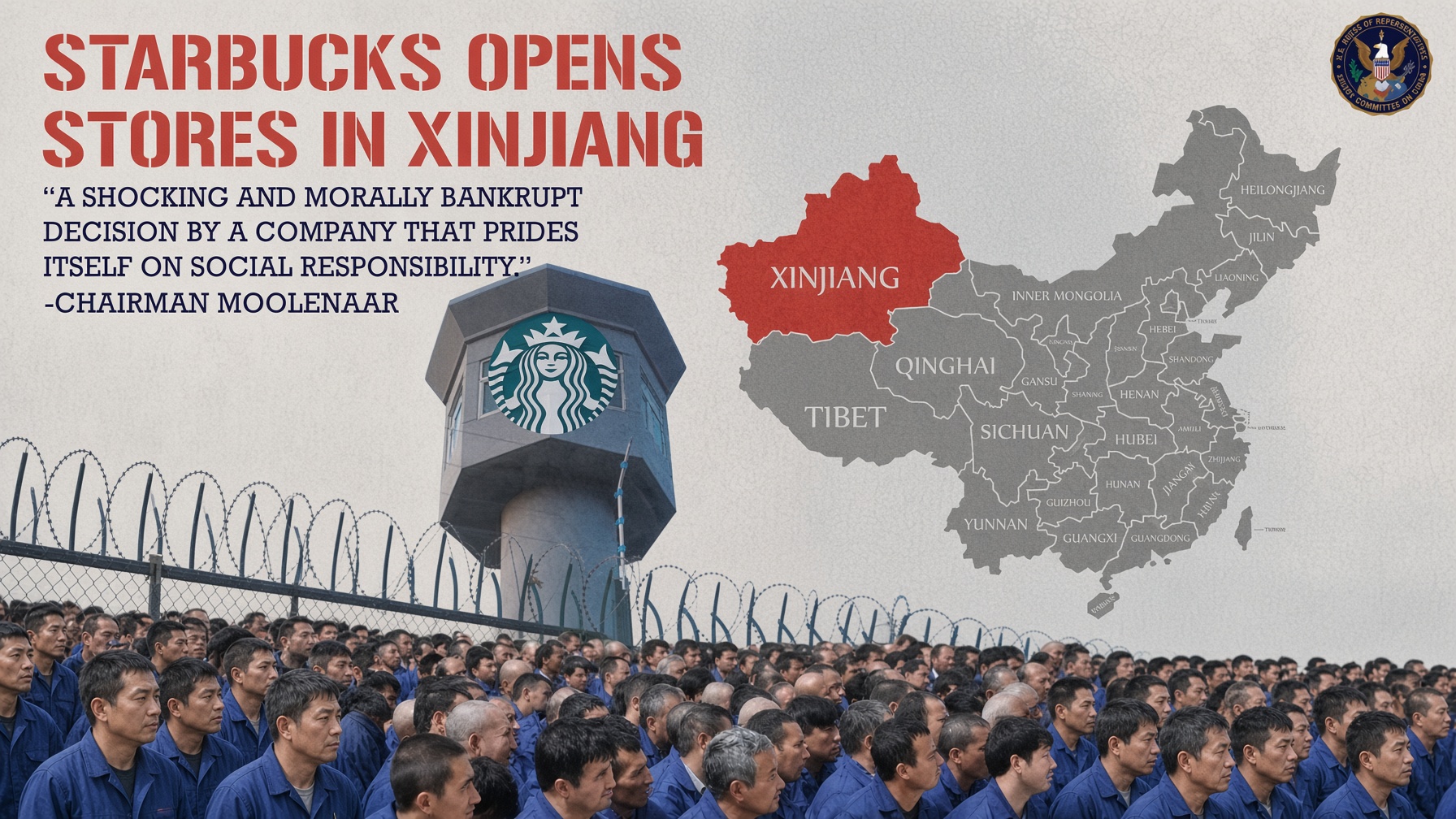
On 29 September 2026, Starbucks opened its first two cafés in Ürümqi, the capital of China’s Xinjiang region. Chinese state media celebrated the arrival while Beijing presented it as evidence of stability and prosperity. U.S. lawmakers and the World Uyghur Congress condemned the move, warning that an international brand could help normalise repression affecting Uyghurs and other Muslim minorities. What began as a business expansion became a political argument: can coffee shops demonstrate freedom where serious human-rights concerns remain unresolved?
Two Cafés, One Political Message
The openings gave China more than new storefronts. They provided a recognisable American brand that officials could point to when defending their account of Xinjiang. Foreign Ministry spokesperson Guo Jiakun rejected criticism from Washington and called allegations of genocide “a blatant lie.” Beijing says its policies have defeated extremism and supported development.
But commercial investment cannot settle a human-rights dispute. A company’s decision to enter a market shows that it sees potential customers. It does not establish whether residents can worship freely, maintain their cultural identity or challenge government policies without fear.
The distinction is important because attractive shopping streets and economic growth can exist alongside restrictions on basic rights. Public relations cannot replace independent investigation.
Uyghur Concerns Behind the Celebration
The World Uyghur Congress accused Starbucks of overlooking the region’s human-rights situation. It stated: “Companies should not contribute to an economy where state-imposed forced labour remains a serious concern.” U.S. House Select Committee on China chairman John Moolenaar called the openings “morally bankrupt.” These are criticisms from advocates and politicians, not findings that Starbucks itself uses forced labour.
The underlying concerns have substantial international weight. In August 2022, the UN Human Rights Office found serious violations in Xinjiang. It concluded that arbitrary and discriminatory detention of Uyghurs and other predominantly Muslim groups, together with broader restrictions, “may constitute international crimes, in particular crimes against humanity.”
The UN assessment did not make a genocide determination. Nevertheless, its findings demand substantive answers. Starbucks’ presence does not overturn them.
Growth Strategy Meets Political Risk
There is a business explanation for the expansion. According to CNBC, Starbucks completed the sale of a controlling 60 percent stake in its China operations to Boyu Capital in April. The venture aims to increase its footprint from roughly 8,000 stores to as many as 20,000. Entering Xinjiang fits that growth strategy.
Yet the political value is equally clear. Eurasia Group’s China director Dan Wang told CNBC: “Chinese authorities have a strong interest in attracting prominent global brands to Xinjiang to demonstrate the region’s stability.” Her assessment explains why a café opening can become useful government messaging.
Businesses can create employment and offer services. Residents should not be denied those opportunities. But companies must recognise when their brands are used to suggest that documented concerns have disappeared.
Starbucks should therefore explain its labour safeguards, supplier checks and procedures for identifying abuse. It should clarify that operating in Xinjiang does not endorse government policies. Transparency would be more convincing than silence.
Freedom Is the Real Test
China argues that development has improved life in Xinjiang. Economic progress deserves examination, but it cannot excuse arbitrary detention or restrictions on religion and culture. Denouncing criticism does not answer specific findings about people’s treatment.
Beijing should address those findings through credible evidence, independent scrutiny and safeguards that protect affected communities. International businesses should demand meaningful accountability rather than allowing their investment to become a substitute for it.
The issue is not whether Ürümqi deserves cafés. It is whether cafés can be presented as proof of justice. They cannot. Prosperity must include freedom, dignity and safety. Until those standards are independently demonstrated, the green Starbucks logo will remain a commercial symbol, not a certificate clearing China’s human-rights record.