

A sweeping transformation of Uyghur religious life is visible across China’s Xinjiang Uyghur Autonomous Region, where thousands of mosques have reportedly been demolished, damaged or stripped of the domes, minarets and gatehouses that once made them recognisably Islamic. Satellite-imagery research has placed the scale of the change far beyond isolated redevelopment: the Australian Strategic Policy Institute (ASPI) estimated that about 16,000 mosques roughly 65 percent of Xinjiang’s total were destroyed or damaged, largely after 2017.
For Beijing, the policy is framed as religious regulation, counter-extremism, public safety and the “Sinicization” of religion. But for Uyghurs and rights researchers, the physical removal of Islamic spaces points to an effort to weaken a distinct religious and cultural identity under Chinese Communist Party rule.
Satellite Evidence Documents Change
ASPI’s 2020 investigation, Cultural Erasure: Tracing the Destruction of Uyghur and Islamic Spaces in Xinjiang, mapped more than 900 mosques and other culturally important Uyghur religious sites, comparing pre-2017 imagery with more recent satellite images. The study then used statistical extrapolation to estimate regional patterns.
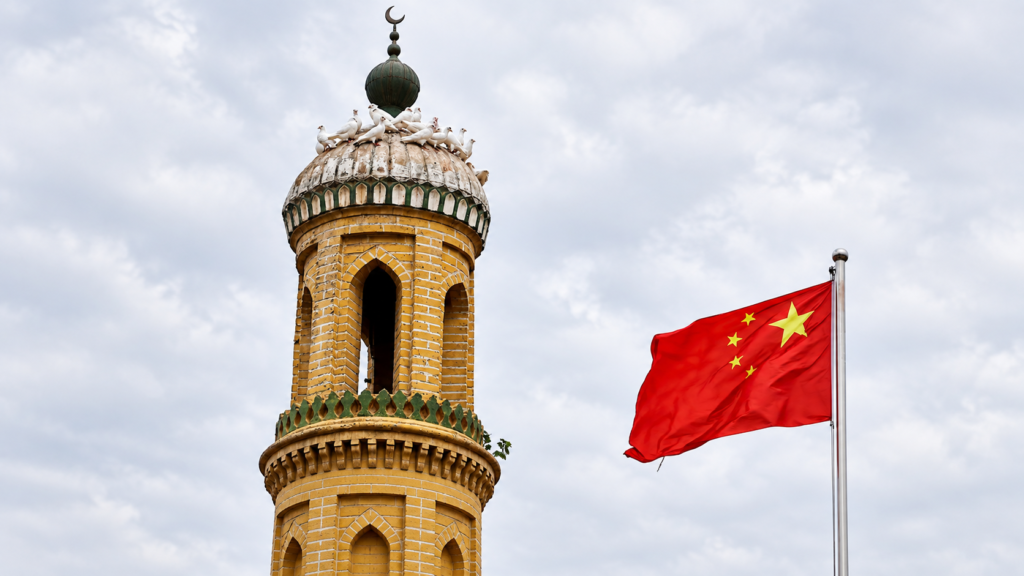
Its central finding was stark: about 8,500 mosques were estimated to have been demolished outright, while thousands more were damaged or “rectified.” The latter category is important. A mosque need not be reduced to rubble to lose its religious character. When authorities remove domes, minarets, Islamic gatehouses and Arabic-script features, the structure may remain standing, yet its visual and communal function can be fundamentally altered.
The Guardian reported that approximately two-thirds of Xinjiang’s mosques were estimated to have been affected. At some demolished locations, satellite images showed vacant land; elsewhere, former mosque sites appeared to have been replaced by roads, parking areas or new construction.
This matters because the scale described by ASPI does not suggest a handful of locally determined renovation projects. The report argues that the pattern reflects a wider government policy that has reshaped the cultural landscape across Xinjiang.
Demolition Was Not the Only Method
Earlier satellite analysis by The Guardian and Bellingcat provided supporting, site-specific evidence. Their investigation reviewed 91 mosques and Islamic sacred sites, finding that 31 mosques and two major shrines had sustained significant structural damage between 2016 and 2018. Fifteen mosques and both shrines appeared to have been completely or almost completely razed.
Other buildings remained but lost domes, minarets and associated structures the very features that publicly identify a building as a mosque. This selective removal is politically significant. It allows Chinese authorities to argue that structures still exist while critics contend that their Islamic identity has been deliberately erased.
The broader cultural impact also extends beyond mosques. ASPI estimated that around 30 percent of important Islamic sacred sites including shrines, cemeteries and pilgrimage routes had been demolished, with a further 28 percent damaged or altered.
For Uyghur Muslims, these sites are not merely buildings. They connect families and communities to burial customs, pilgrimage, memory, worship and generations of local religious life. Their removal weakens the physical infrastructure through which a minority community preserves its faith and historical continuity.
Beijing Denies Systematic Destruction
The Chinese government strongly rejects the allegation that it has systematically dismantled Uyghur Islamic heritage. After the ASPI report was published, China’s Foreign Ministry said Xinjiang had more than 24,000 mosques claiming one mosque for every 530 Muslims and arguing that the region had more mosques per capita than many Muslim-majority countries.
Foreign Ministry spokesperson Wang Wenbin called ASPI’s findings “nothing but slanderous rumours” and accused the institute of receiving foreign funding to “support its concoction of lies against China.”
Yet this response largely disputes the interpretation and motives behind the research rather than resolving the satellite evidence of physical change at individual religious sites. Beijing’s emphasis on the total current number of mosques also does not directly answer whether earlier mosques were demolished, converted or deprived of Islamic architectural features.
Why Xinjiang Mosque Destruction Matters
The struggle over Xinjiang’s mosques is ultimately a struggle over control: who decides how Uyghurs may visibly practise Islam, preserve their heritage and define their community identity?
China presents its approach as modern governance and counter-extremism. However, the reported demolition and “rectification” of thousands of mosques suggest a deeper campaign to bring Uyghur religious life under state-approved political and cultural norms. Satellite imagery cannot, by itself, prove every motive behind every demolition. But it makes the transformation difficult to deny: across Xinjiang, places once clearly identifiable as mosques have vanished or been visibly stripped of their Islamic character.
Disclaimer
The front image used in this post is AI-generated and intended solely for illustrative purposes. It does not represent an actual event or photograph. This post is shared for informational and public-awareness purposes. It is not intended to criticize, disrespect, target or demean any religion, ethnic group, nationality, government or community. The information is presented to provide context and encourage informed and respectful discussion.