

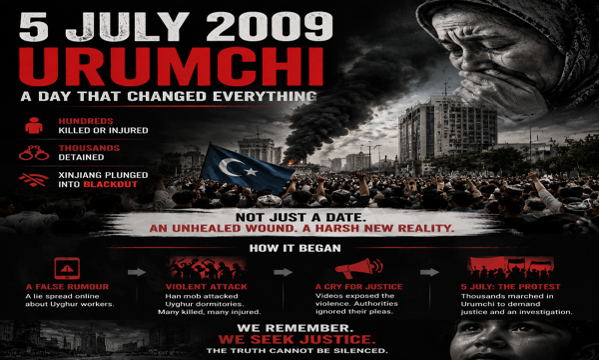
Seventeen years ago, the streets of Urumchi witnessed a day that would forever alter the lives of the Uyghur people and their relationship with the Chinese government. On 5 July 2009, thousands of young Uyghurs marched into the city’s centre. What began as a demand for justice ended in one of the deadliest episodes of ethnic violence in modern Chinese history. When the dust finally settled, hundreds of people were dead or injured, thousands had been detained and the entire region of Xinjiang was plunged into an unprecedented blackout. Today, for the Uyghur community around the world, this anniversary is not just a date in a history book. It represents an unhealed wound and the beginning of a harsh new reality.
The tragic events in Urumchi actually started thousands of miles away in a factory in southern China. In late June 2009, a fabricated rumour spread online claiming that Uyghur factory workers had assaulted Han Chinese women. Even though the person who posted the rumour later admitted it was a lie, the damage was irreversible. A mob of Han workers attacked the Uyghur dormitories, resulting in deaths and over a hundred injuries. As videos of the brutal beatings circulated online, Uyghurs felt the authorities were ignoring the violence and failing to protect them. This deep sense of injustice drove the protesters to gather in Urumchi on 5th July to demand a real investigation.
Exactly what happened during that protest remains the subject of bitter dispute, with two vastly different accounts of the tragedy. The Chinese government maintains that the gathering quickly turned into a premeditated riot, with Uyghur mobs violently attacking Han Chinese residents, burning cars and looting shops. Official reports stated that 197 people died, the majority of them Han civilians and Beijing blamed exiled Uyghur groups for organizing the chaos. However, the Uyghur community and human rights organizations tell a different story. They argue that the demonstration was peaceful until armed security forces arrived and used lethal force against the crowds. In the days that followed, vigilante violence also erupted as armed Han residents marched through Uyghur neighbourhoods.
Because of what happened next, the world struggled to uncover the truth. The Chinese government completely cut off Xinjiang’s internet access for nearly ten months, imposing one of the largest and longest communication blackouts in history. During this time of silence, human rights groups reported that hundreds of Uyghurs were subjected to rushed, unfair trials, resulting in prison terms and executions. Dozens of Uyghur men and boys were swept up by security forces and simply vanished. Their families have never seen or heard from them again and demanding answers for these disappearances remains a central focus for the Uyghur diaspora today.
Looking back, historians and human rights advocates recognize the summer of 2009 as a major turning point. After the Urumchi unrest, the Chinese state shifted its approach in Xinjiang from managing ethnic tensions to imposing strict, overwhelming security. This paved the way for the extreme measures seen in recent years, including massive facial recognition networks, data collection and the creation of a vast internment camp system. Researchers estimate that over a million Uyghurs and other Muslim minorities have been held in these camps. While the United Nations and several countries have labeled these actions as crimes against humanity or genocide, Beijing firmly rejects this, describing the facilities as vocational training centres designed to combat terrorism and reduce poverty.
Seventeen years later, the dust has settled on the streets of Urumchi, but the core questions of that violent July remain unanswered. With no independent investigations allowed and strict limits placed on journalists in Xinjiang, the complete truth of the death toll and the fate of the missing may never be fully known. Yet, the memory of 5 July 2009, refuses to fade. Every year, Uyghurs around the globe gather to hold up photos of their missing loved ones, serving as a powerful reminder of a tragedy that continues to shape their present and future. They continue to raise their voices, asking the world to remember, to seek the truth and to never look away.