
A Uyghur father died in 2018, but his family was told a story that never made sense: a man held in “re-education” had supposedly been killed in a traffic accident. Now, an October 15 investigation by Radio Free Asia reports that police confirmed Yasinjan Tohti died in custody in Aksu, Xinjiang. The bus driver had faced repeated detention over suspected “religious radicalism,” including scrutiny of his son’s education in Egypt. The findings challenge the explanation given to his relatives, but do not establish the medical cause of death. Eight years later, his family still deserves answers: what happened, why was the truth withheld and who will be held accountable?
A Uyghur Father Who Wanted His Son to Learn
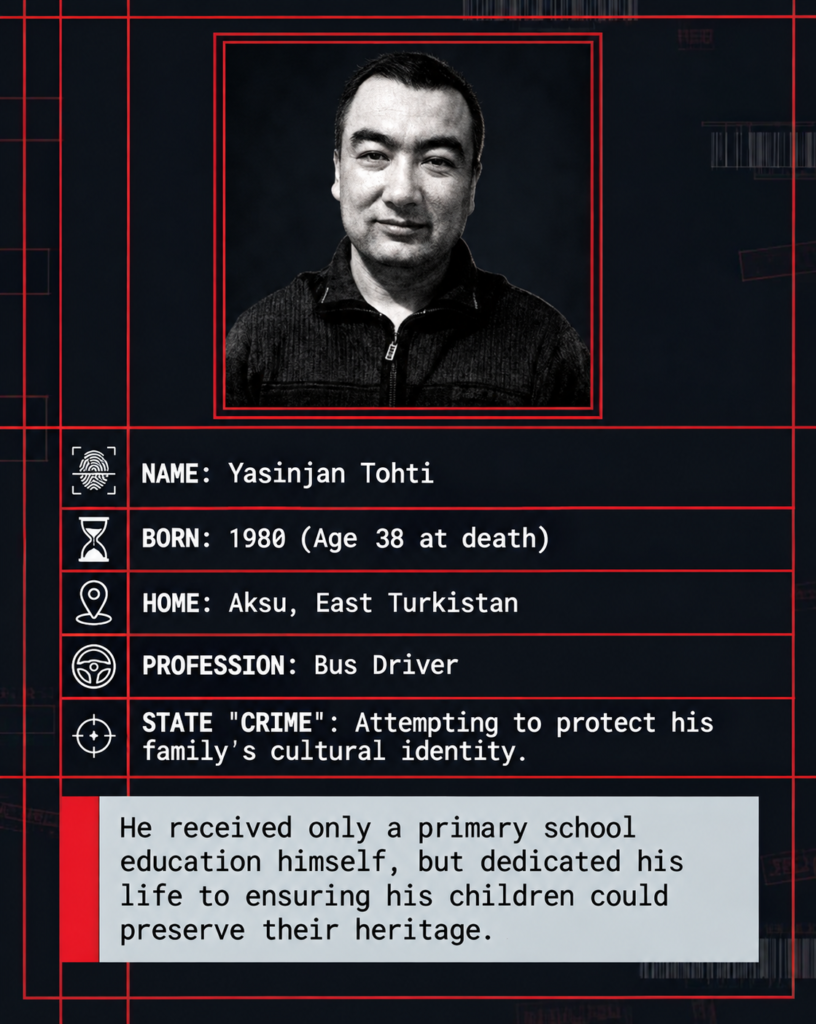
Born in Aksu in 1980, Yasinjan lived and worked there throughout his life. He had received only a primary-school education but wanted more opportunities for his son, Hebibulla.
According to RFA, he sent the boy to Egypt at five years old, where Yasinjan’s sister was already overseeing her own children’s education and agreed to care for him. For the family, education abroad offered a way to preserve language, faith and cultural identity.
That decision later brought suspicion. A father’s effort to educate his child became part of the chain of events leading to repeated detention.
Four Detentions and a Final Disappearance
Yasinjan’s sister, Reyhangul Tohti, told RFA that authorities detained him repeatedly between 2016 and 2018 because his son was in Egypt. Officials compelled him to bring Hebibulla home but the suspicion continued.
He was reportedly held four times. His final detention followed an incident in which he stopped his bus to allow Muslim passengers to observe the call to prayer. He died during that detention.
These reported circumstances raise a fundamental concern: peaceful religious behaviour and family connections abroad were treated as reasons for coercive state intervention. Neither should replace evidence of an actual crime.
The Accident Explanation That Never Added Up
Reyhangul, who lives in Belgium, learned of her brother’s death through a younger sister in 2018.
“How could someone held in ‘re-education’ die in a traffic accident?” she recalled asking.
Her sister’s response exposed the fear surrounding the family: “That is what the police told us. We have to accept that explanation. Under the current circumstances, we cannot ask any further questions about it.”
A family should never have to choose between asking about a death and protecting its own safety. Silence obtained through fear is not acceptance.
Police Accounts Challenge the Official Story
RFA telephoned the Qartal Bazaar police station in Aksu in October 2026. Two police personnel provided information contradicting the accident account.
However, important details remain unresolved. One referred to “five or six months” in detention; another described hospital transfer after “nine or ten days.” RFA could not establish precisely what those periods represented.
The investigation supports the conclusion that Yasinjan died in custody. It does not establish whether illness, mistreatment, medical neglect or another cause led to his death.
That distinction strengthens the demand for an independent investigation.
More Relatives, More Unanswered Questions
The suffering did not end with Yasinjan’s death. Reyhangul later learned that the sister who informed her had been detained for allegedly “leaking state secrets.” Their mother was reportedly detained after travelling to Turkey, described as a “sensitive country.” Their locations and sentence lengths remained unknown to her.
One family’s grief became several overlapping searches for answers. China’s authorities should disclose detention records, permit family contact and explain the legal grounds for each case.
A Death Requires Truth, Not Silence
Beijing must release Yasinjan’s medical and custody records and allow independent scrutiny. His relatives deserve to know how he died.
Yasinjan was a father, not merely a name in a detention report. Restoring his dignity begins with something basic: telling his family the truth, without forcing them to fear the consequences of asking.