
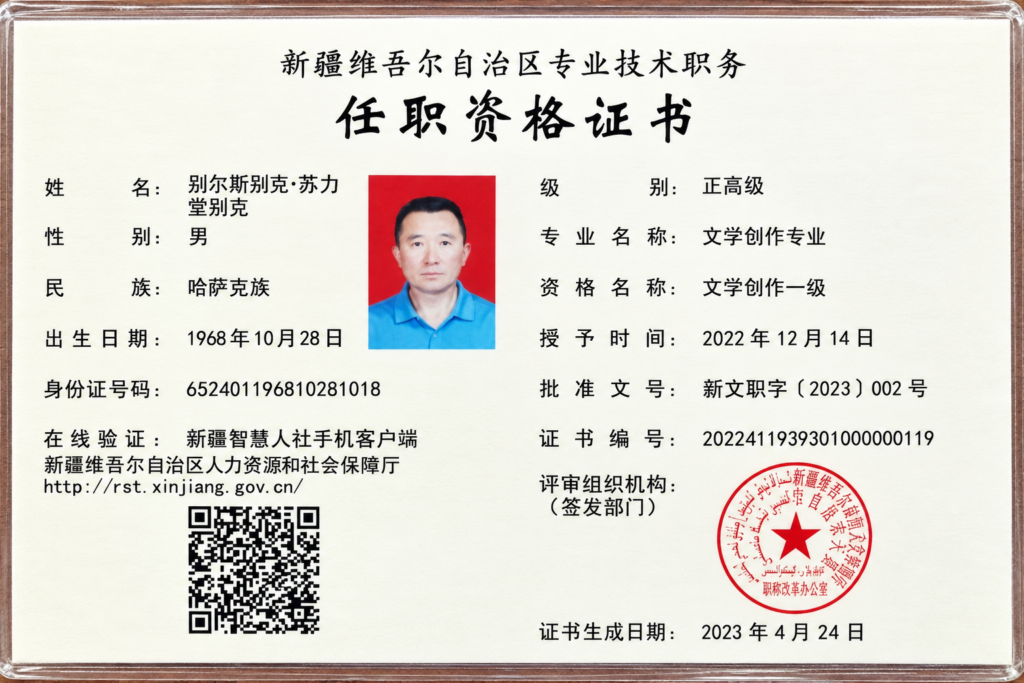
The disappearance of Beersbek Abdurezhak, a Kazakh poet and writer from China’s Xinjiang Uyghur Autonomous Region, has raised concerns among relatives and members of the Kazakh diaspora. According to information provided by family members and diaspora activists, Beersbek was detained in December 2025 and has since been moved between locations without his family receiving clear information about his legal status.
For his family, the unanswered questions are deeply personal. They say they do not know precisely where he is being held, what formal charges may have been brought against him or whether he has been able to obtain regular access to legal representation. His case comes amid continuing international scrutiny of the treatment of Uyghurs, Kazakhs and other predominantly Muslim communities in Xinjiang.
The wider pattern has already attracted international attention. RFE/RL has reported on the disappearance of prominent Kazakh writer Zhengis Reskhan, while Amnesty International said in July 2026 that Reskhan had been held since March without his family receiving official notification of his detention, legal status or reasons for his detention.
A Kazakh poet disappears in the Uyghur Region
Beersbek Abdurezhak, also known by the legal name Beersbek Sultangbek, was reportedly detained by the Ili Public Security Bureau in late December 2025, according to material attributed to relatives and Kazakh diaspora activists.
His family says he was initially held in Yining, also known as Ghulja, in the Ili Kazakh Autonomous Prefecture. They reportedly received occasional brief telephone contact with him, sometimes at intervals of 10 to 15 days.
The situation later became more uncertain. According to the family’s account, police collected Beersbek’s clothing from the family home and told his wife that he had been transferred to Urumqi, the capital of the Xinjiang Uyghur Autonomous Region.
The family says it was not provided with detention documents, a case number or clear information about whether prosecutors or a court had formally taken up the case.
Those details have not been independently confirmed by major international media or Chinese authorities in sources they could locate.
The Uyghur Region has a wider record of minority writers being detained
Beersbek’s reported disappearance comes against a broader backdrop involving writers and intellectuals from Xinjiang’s ethnic minority communities.
The case of Zhengis Reskhan is one of the clearest examples documented by international sources. RFE/RL reported in June that the prominent ethnic Kazakh writer had not been seen since March 2026 and that his family had not received an official detention notice or explanation of the charges.
Amnesty International subsequently documented that Reskhan had been detained since March 19 after months of police interrogations. According to the organization, his family had received no official notification of his detention, legal status or reasons for the detention and had no contact with him.
RFE/RL later reported that Reskhan faced a closed-door trial and that his family said he had been accused of “undermining ethnic unity.” The report also connected his case to China’s new Law on Promoting Ethnic Unity and Progress, which came into effect on July 1, 2026.
These documented cases provide important context for understanding why the reported detention of another Kazakh writer has attracted attention.
Uyghur identity and Kazakh culture under pressure
The Xinjiang Uyghur Autonomous Region is home to several predominantly Muslim ethnic communities, including Uyghurs and ethnic Kazakhs. Cultural expression, language, religious practice and links with communities outside China have all become subjects of international scrutiny.
For writers, poets, teachers and cultural figures, literature can be more than creative expression. It can preserve language, collective memory and traditions across generations.
That makes the disappearance of an intellectual particularly significant for diaspora communities.
In Reskhan’s case, Amnesty International described him as a prominent Kazakh writer and noted that he had published 13 literary works, including children’s literature and humorous works, with some officially translated from Kazakh into Chinese.
RFE/RL similarly described him as a writer and satirist who had worked as a teacher, editor and cultural official.
The cases therefore raise a broader question about the space available for minority-language cultural expression in the Uyghur Region.
Families left searching for answers
For Beersbek’s family, the most immediate issue is not political interpretation but basic information about his whereabouts.
According to the account provided by relatives, his mother, a Kazakh citizen living in Kazakhstan, appealed publicly to Kazakh President Kassym-Jomart Tokayev for assistance in locating her son and securing his release.
The family says it has not received written confirmation of detention, an indictment or a trial date. It also says it remains unclear whether Beersbek has had regular access to a lawyer.
Such uncertainty has also appeared in the documented case of Reskhan. Amnesty International reported that his family had received no official notification concerning his legal status or reasons for detention.
RFE/RL reported similar concerns from Reskhan’s son, who said the family had struggled to obtain formal information from Chinese authorities.
The international concern over Uyghur Region detentions
The cases of Beersbek and Reskhan should not automatically be treated as identical. The available evidence surrounding them is different, and Beersbek’s reported detention has not been independently verified through the same range of international sources currently available for Reskhan.
Nevertheless, the cases illustrate why transparency around detention is important.
When families are unable to establish where a relative is being held, what charges have been filed or whether judicial proceedings have begun, independent verification becomes extremely difficult.
International human-rights organisations have repeatedly raised concerns about arbitrary detention and other restrictions affecting ethnic minorities in Xinjiang. Amnesty International’s documentation of Reskhan’s case specifically raises concerns about secret detention and the absence of publicly disclosed legal information.
At the same time, Chinese authorities maintain that their policies in Xinjiang are directed toward combating terrorism and extremism and reject allegations of widespread abuses. RFE/RL noted that Beijing continues to defend its Xinjiang policies on those grounds.
Why the Uyghur Region’s missing writer’s matter
A missing poet is not simply a missing individual for the community that reads his work.
For Kazakh and Uyghur communities across Xinjiang and Central Asia, writers can carry language, history and cultural memory from one generation to another. When a writer disappears and relatives cannot obtain clear information about his legal status, the consequences extend beyond the immediate family.
The reported case of Beersbek therefore raises questions that require further independent documentation: Where is he being held? Has a formal case been opened? What charges, if any, have been filed? Has he been given access to a lawyer and family members?
Those questions remain unanswered in the publicly available evidence reviewed for this article.
What is clearer is that his reported disappearance comes at a time when the treatment of minority intellectuals in the Uyghur Region remains under international scrutiny. The documented detention of Zhengis Reskhan demonstrates that concerns involving Kazakh writers are not confined to a single case.
For families waiting across the border, however, the issue remains painfully simple: they want to know where their relatives are, why they were detained and whether they will be allowed to return home.