

When China sentenced Uyghur economics professor Ilham Tohti to life in prison in Urumqi in September 2014, it did more than punish one man it exposed a state willing to crush peaceful dialogue whenever that dialogue challenged its power. Arrested in Beijing in January 2014 and later tried in a closed court in Xinjiang, Tohti was not a militant or separatist but a scholar who founded Uighur Online to promote understanding between Uyghurs and Han Chinese and to speak openly about discrimination, rights and coexistence. According to the BBC, he was a fierce critic of China’s treatment of the Uyghur people, while Human Rights Watch described his prosecution as politically motivated and the trial as profoundly unjust. Even after his conviction, the case continued to draw global condemnation, with the European Parliament later awarding him the 2019 Sakharov Prize for Freedom of Thought.
Uyghur voice under pressure
Ilham Tohti built his public life around scholarship, not rebellion. He taught economics at the Central University for Nationalities in Beijing and founded Uighur Online, a website focused on Uyghur issues and mutual understanding between Uyghurs and Han Chinese. He argued for dialogue, regional autonomy and peaceful coexistence, while clearly opposing violence and separatism. That is exactly why his case is so disturbing: a government that claims to fear extremism chose to silence one of the most moderate Uyghur voices in public life.
BBC reported that Tohti had been “a fierce critic” of China’s treatment of the Uyghur people and that his imprisonment drew international attention because he had spent years trying to explain tensions rather than inflame them. Human Rights Watch likewise emphasized that there was no public evidence he had incited violence or unlawful action. In a fair system, a professor like Tohti would be debated, not jailed.
Closed trial in Urumqi
Tohti was arrested in Beijing in January 2014 and transferred to Urumqi, the capital of Xinjiang, where he was later charged with separatism. Human Rights Watch said his case was riddled with due process violations and that the appeal process was handled in a way that grossly violated basic rights. He was sentenced to life imprisonment in September 2014 after a closed trial, and the court later upheld that verdict.
That closed trial matters because it shows how China handles political cases involving Uyghur intellectuals: behind closed doors, with limited transparency and with the outcome seemingly decided in advance. China has often claimed that its harsh Xinjiang policies are about stability and counterterrorism but Tohti’s case does not fit that explanation. He opposed separatism, rejected violence and still received a life sentence. That contradiction reveals a system less interested in justice than in control.
Who was hurt most
The suffering did not stop with Tohti. His family has lived with the pain of separation, while his students and supporters have also faced the consequences of association. Human Rights Watch later reported that several of his students were imprisoned as well, with six of seven listed students believed to have been sentenced in late 2014. This is what repression looks like in practice: one person is punished, then the circle around him is punished too.
The European Parliament later awarded Tohti the Sakharov Prize for Freedom of Thought in 2019, recognizing his efforts to foster dialogue and defend the rights of China’s Uyghur minority. His daughter accepted the award on his behalf, a moment that made his absence even more painful. Human Rights Watch continued calling for his release and in 2024 it urged China to free him on the 10th anniversary of his sentencing.
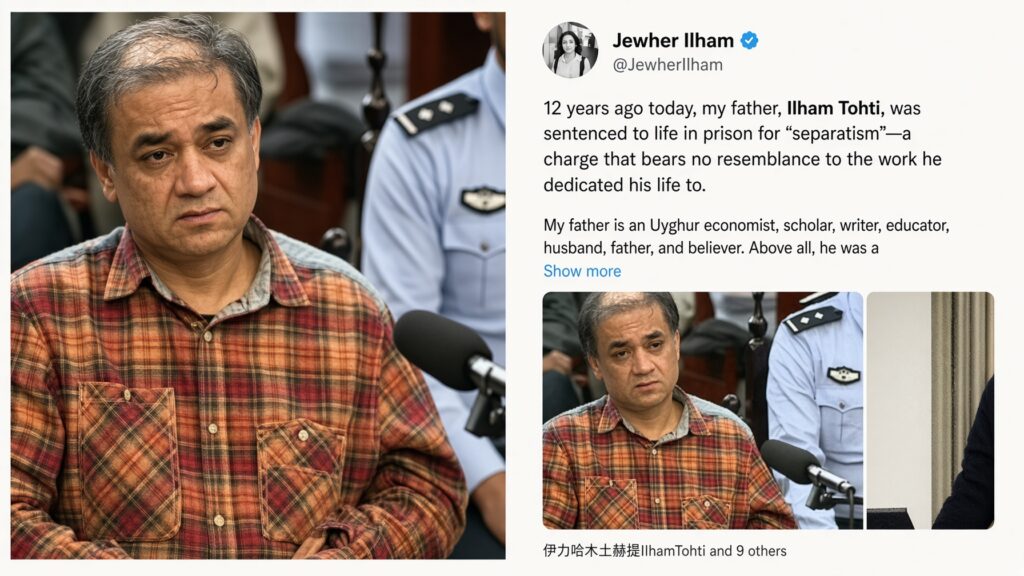
still stands as a reminder of a scholar never forgotten.
What China fears
China’s treatment of Tohti shows that the state fears more than protest; it fears credibility. A militant can be dismissed as a security threat but a professor who speaks calmly, logically and morally to both Uyghurs and Han Chinese is harder to discredit. That is why Tohti became so dangerous to Beijing: he represented a peaceful alternative to repression.
His case also shows how China uses law as a political instrument. Charges of separatism, closed hearings and years of silence about his condition all point to a system designed to intimidate, not to judge fairly. The state did not just imprison Ilham Tohti. It tried to bury the idea that Uyghurs can demand dignity without being labelled enemies.
For Gen Z, his story is a reminder that freedom of expression is not an abstract slogan. It is the difference between a classroom and a cell, between dialogue and disappearance, between a society that listens and one that silences. Ilham Tohti’s life still matters because it proves that peaceful words can threaten authoritarian power more than violence ever could.