

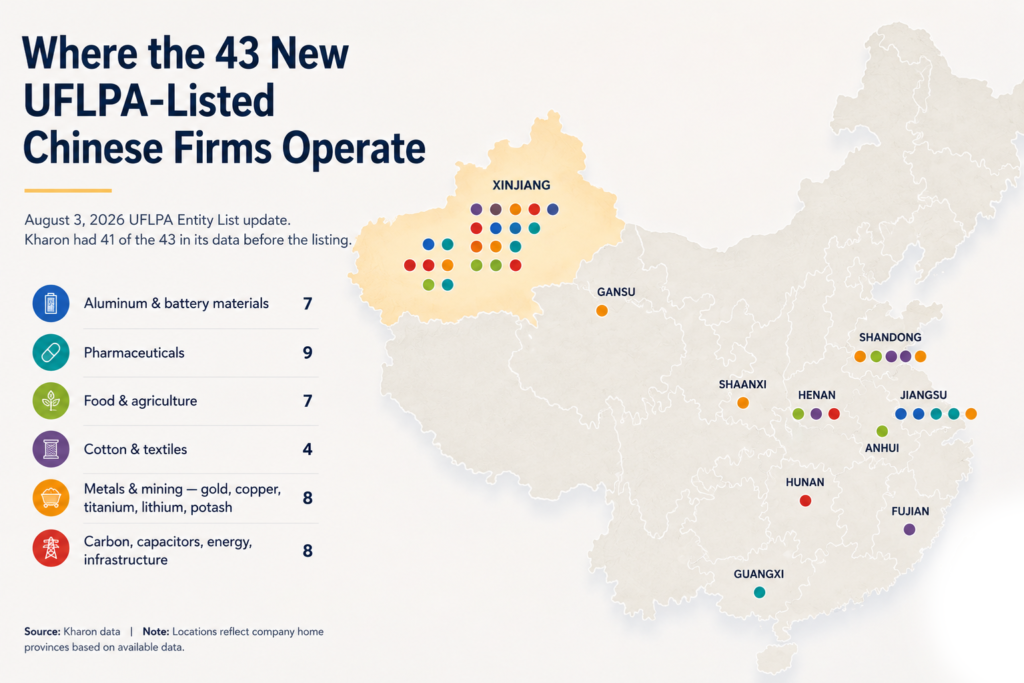
In the most sweeping single expansion of its forced-labor enforcement to date, the United States has added 43 Chinese companies to an import blacklist tied to alleged human rights abuses against Uyghurs and other ethnic minorities in East Turkestan. Announced by the U.S. Department of Homeland Security (DHS) on Friday and taking effect Monday, the move brings the total number of entities on the Uyghur Forced Labor Prevention Act (UFLPA) Entity List to 187, a 30 percent increase, as Washington intensifies pressure on Beijing over its treatment of Turkic Muslim communities in the northwestern region.
What the Sanctions Mean
Under the UFLPA, goods produced by listed entities face a “rebuttable presumption” of being made with forced labor and are barred from entering the U.S. unless importers can prove otherwise. The newly designated companies span aluminium, apparel, copper, cotton, tomatoes and downstream products sectors long scrutinized for links to East Turkestan ’s state-sponsored labor transfer programs.
Among those blacklisted are Hunan Aihua Group, one of China’s largest capacitor manufacturers, snack food producer ChaCha Food, and Henan Tongzhou Cotton Industry Co, according to U.S. government notices. The move marks the first such expansion under the Trump administration, which has vowed to maintain a hardline stance on China’s internal policies even as it seeks trade stability.
International Media Coverage and Reactions
Reuters reported that the U.S. action underscores Washington’s continued enforcement of the UFLPA, which was enacted in June 2022 to combat what American officials describe as genocide and crimes against humanity in East Turkestan. The agency noted that Beijing has “regularly dismissed accusations of forced labour and other abuses against Uyghurs,” framing them as politically motivated.
China’s Ministry of Commerce swiftly rejected the U.S. allegations, calling them “groundless” and accusing Washington of disrupting global supply chains. “The U.S. actions have no factual basis,” a ministry spokesperson said, echoing state media narratives that portray the sanctions as economic coercion disguised as human rights enforcement.
The China Cotton Association condemned the move as a violation of international trade principles, warning that the sanctions “undermined the global cotton industry chain.” Similarly, Global Times described the blacklist as “destructive bullying,” while China Daily warned that unilateral sanctions risk destabilizing industrial and supply chains worldwide.
Broader Implications for Trade and Human Rights
The expansion of the UFLPA Entity List signals a deepening of U.S. efforts to isolate East Turkestan -linked supply chains, even as American importers face mounting compliance burdens. DHS described the move as the “largest single expansion” of the list since the law took effect, emphasizing that U.S. Customs and Border Protection will now apply stricter scrutiny to goods from the newly listed firms.
For businesses, the update means enhanced due diligence is required to document supply chain origins before cargo reaches U.S. ports. Failure to comply could result in seized shipments, fines, or legal action under U.S. trade laws.
Human rights advocates, however, welcomed the move as a necessary step to hold Beijing accountable. Uyghur Times framed the sanctions as part of ongoing U.S. enforcement against “forced labor of Uyghurs and other persecuted ethnic groups from the Uyghur homeland,” highlighting the moral imperative behind the economic measures.
A Geopolitical Flashpoint
The latest sanctions arrive amid heightened U.S.-China tensions over trade, technology and security, with East Turkestan remaining a key flashpoint. While Washington frames the UFLPA as a human rights tool, Beijing views it as part of a broader containment strategy aimed at curbing China’s economic rise.
As the blacklist grows, so does the pressure on global companies to audit their supply chains and distance themselves from East Turkestan -linked production. For the Uyghur community and international advocates, the sanctions represent both a symbolic and practical challenge to China’s policies in the region though Beijing shows no sign of reversing course.