
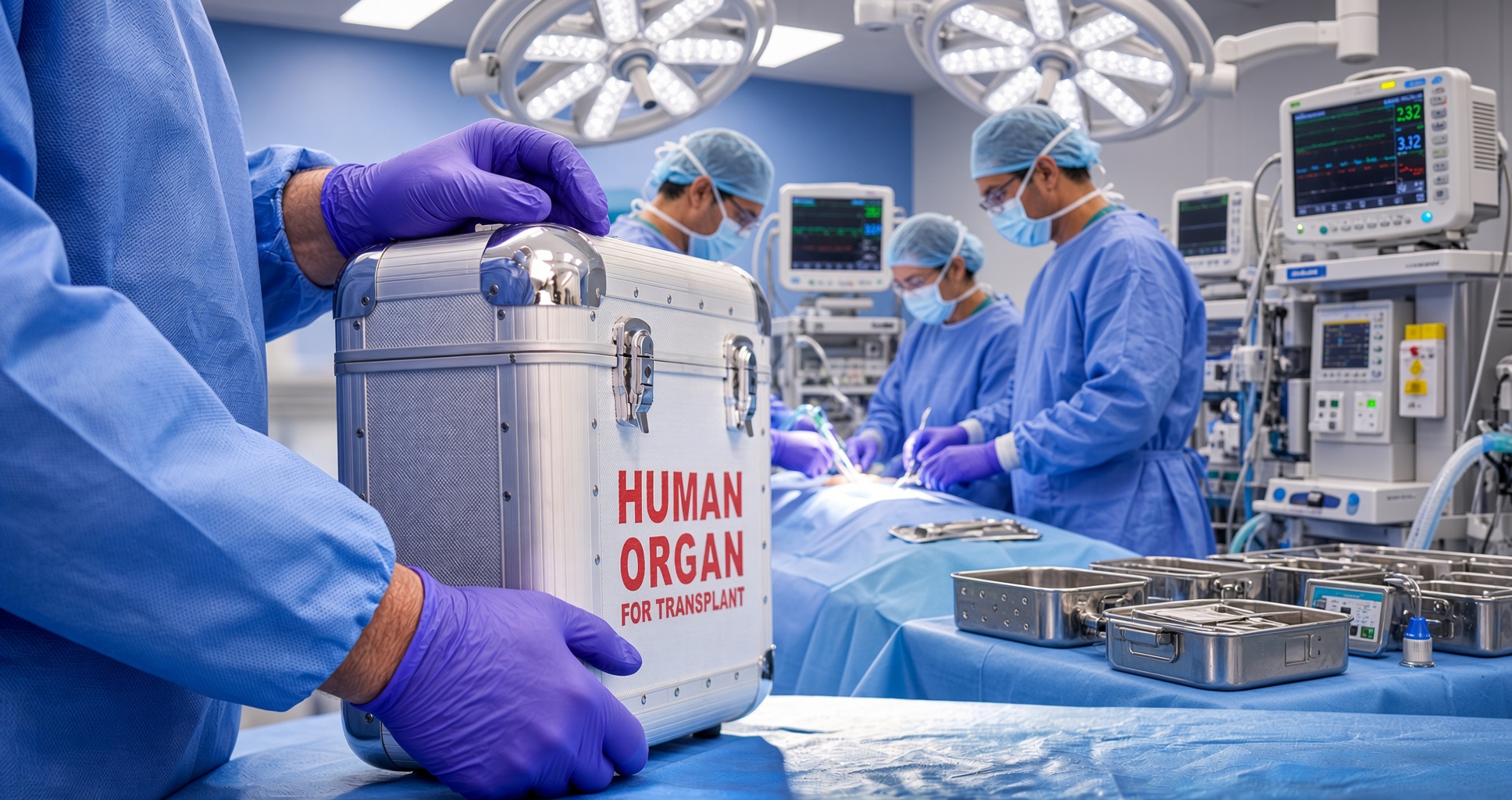
A hospital should save lives. But China’s plan to expand organ-transplant facilities in Xinjiang has produced a more troubling question: where will the organs come from? The Chinese government plans to add six transplant medical centres by 2030, increasing the number of transplant-capable institutions in the region from three to nine. For Uyghurs living under a heavily controlled system, the announcement brings fear rather than reassurance.
Why the Uyghur Context Matters
Xinjiang is home to millions of Uyghurs and other Turkic Muslim communities. Governments, UN experts, researchers and rights groups have documented or raised concerns about mass detention, intensive surveillance, forced labour and restrictions on religious and cultural life. China rejects these claims. It says its policies fight extremism, create employment and promote development.
Yet transplant policy cannot be separated from this wider setting. When a state controls movement, speech, communication and access to independent lawyers or journalists, it becomes difficult to establish whether consent is truly free. Uyghur organisations and international rights groups are therefore asking for transparent answers.
China’s Plan for Six Centres
The reported 2024 to 2030 regional plan calls for six additional medical institutions with organ-transplant capacity. Four are reportedly planned for Urumqi, the regional capital. Other facilities are expected across northern, southern and eastern Xinjiang.
The centres would cover heart, lung, liver, kidney, small-intestine and pancreas transplants. More facilities could help patients who need care. But a larger system also needs a clear and ethical supply of donated organs. China has not publicly provided enough information to show why such a large expansion is needed in Xinjiang.
Low Donation Rates, Big Questions
Human-rights groups say Xinjiang’s reported voluntary organ-donation rate is 0.69 donors per million people, below China’s reported national average of 4.66. Yet the region’s number of transplant-capable institutions could triple.
ETAC, the International Coalition to End Transplant Abuse in China, says the expansion appears disproportionate for a region of roughly 26 million people. It notes that Xinjiang could have nine transplant-capable institutions while Guizhou, a province with a larger population, has three. This comparison does not prove abuse. It does, however, raise serious questions.
Why are nine centres necessary? How many operations will they perform each year? How many organs will come from voluntary donors? What are the waiting times? Who independently checks that consent is real? Without clear data, trust is not enough.
Uyghur Detention and Consent
The issue is not transplantation. Patients who need a transplant deserve life-saving care. The issue is whether each organ donor has given free, informed and verifiable consent.
In Xinjiang, Uyghurs have faced detention, political pressure and pervasive surveillance. Reports describe the collection of biometric and medical data. In this climate, consent cannot be assumed. A detainee, prisoner or person whose family faces pressure may not be able to refuse freely.
If China’s transplant system is ethical, independent evidence should be able to prove it. But restrictions on access to Xinjiang have made verification difficult.
What UN Experts Said
In 2021, UN human-rights experts said they were alarmed by allegations that detainees from ethnic, religious and linguistic minorities in China were subjected to blood tests, ultrasounds and organ examinations without informed consent. They said the resulting information was reportedly placed in a database of living organ sources.
The experts did not conclude that every transplant in China involved abuse. They asked China to provide information about organ sources, transplant waiting times and donation procedures. They also called for independent international monitoring.
China says it stopped using organs from executed prisoners in 2015 and now relies on voluntary donations. If that is true, it should permit independent medical and human-rights observers to examine the new facilities and their safeguards.
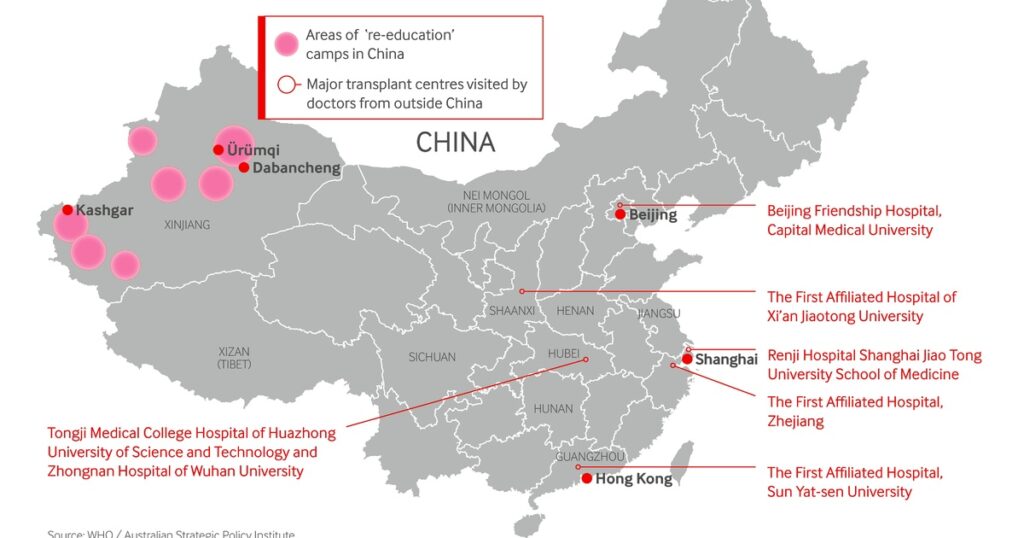
Map showing major transplant centres and areas associated with reported re-education camps in China.
Conclusion: Consent Cannot Be Secret
China presents the six new centres as a health-care investment. But in Xinjiang, health policy cannot be separated from Uyghur experiences of detention, surveillance and repression. The expansion itself does not prove forced organ harvesting. It does make transparency urgent.
The basic test is simple. Can China demonstrate that every organ comes from a person who gave free, informed and voluntary consent? Until Beijing allows credible independent verification, Uyghur concerns will remain. A medical system meant to save lives must never rely on secrecy, fear or the loss of another person’s freedom.