

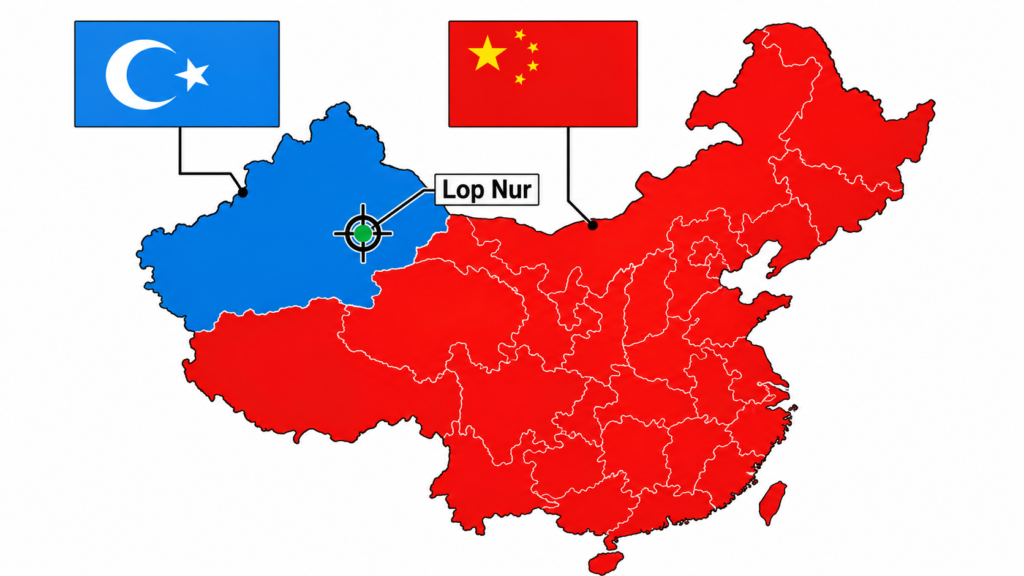
China’s nuclear weapons programme was built in Lop Nur, a remote area in today’s Xinjiang Uyghur Autonomous Region but questions about who bore the human and environmental cost have never been fully answered. Between 1964 and 1996, Beijing conducted 45 nuclear explosions at the Lop Nur test site, including atmospheric detonations that released radioactive fallout into the wider environment. For Uyghur communities living in and around the region, this history remains inseparable from broader accusations that the Chinese state has repeatedly treated their homeland as a militarised frontier rather than a place where local people have equal rights, safety and access to information.
China’s nuclear rise began in Lop Nur
On October 16, 1964, China detonated its first atomic bomb at Lop Nur, becoming the world’s fifth nuclear-armed state. The site was chosen in the arid northwest, near the Taklamakan Desert, in an area Chinese authorities portrayed as remote and suitable for weapons testing.
According to the Los Alamos National Laboratory, China established the Lop Nur Nuclear Test Base in 1959 and carried out 45 atmospheric and underground nuclear tests there between 1964 and 1996. The site was also used for China’s first hydrogen-bomb test in June 1967.
However, the official description of Lop Nur as an empty wasteland has long been challenged by the reality of life across the broader region. Uyghur, Kazakh and other communities lived in areas potentially affected by radioactive fallout, including pastoral populations dependent on livestock, water sources and land.
The UN’s nuclear-test history states that China conducted all 45 of its known nuclear tests at Lop Nur. It also notes that China continued atmospheric testing until 1980, 17 years after the Partial Test Ban Treaty prohibited such explosions in the atmosphere, underwater and outer space for participating states. China was not a party to that agreement.
Fallout and the unanswered health toll
Of China’s 45 known tests, 23 were atmospheric and 22 were underground, according to a 2022 assessment prepared for the International Campaign to Abolish Nuclear Weapons by the Institute for Energy and Environmental Research and International Physicians for the Prevention of Nuclear War. Atmospheric tests are especially significant because radioactive material can spread through air, soil, food systems and water.
The report found that radioactive iodine-131 contamination after Chinese nuclear explosions was described as “significant” in some areas. It cited data showing iodine-131 deposition in Lanzhou after a 1974 atmospheric test and in Xining after a 1980 test. It further warned that herders, children and people consuming contaminated snowmelt or milk could face higher exposure risks.
According to the same report, the Chinese government has not published official health studies or comprehensive estimates of the human and environmental damage caused by the Lop Nur tests. This absence of transparent data leaves Uyghur families and independent researchers unable to establish the full health consequences, including possible patterns of cancer, leukaemia, infant illness or congenital disabilities.
Why Beijing’s secrecy matters
The central issue is not only that China tested nuclear weapons in a Uyghur-majority region; it is also that Beijing has kept the human record of those tests largely beyond independent scrutiny.
The IEER-IPPNW assessment noted that a senior Chinese military official acknowledged in 1989 that “a few deaths” had occurred, though the statement offered no number, evidence or public accounting. The report also cited information that China began providing payments to some military personnel and civilians who participated in nuclear tests an action that raises further questions about exposure and responsibility
Environmental contamination has not simply disappeared with time. The 2022 assessment estimated that approximately 14,000 terabecquerels of strontium-90, 23,000 terabecquerels of caesium-137 and roughly 50 kilograms of plutonium-239 remained in the environment from China’s atmospheric testing, after decay correction to 2020. These figures do not automatically establish individual illness but they reinforce the need for transparent long-term monitoring and independently reviewed health research.
A Uyghur demand for truth and accountability
China stopped explosive nuclear testing in July 1996 and signed the Comprehensive Nuclear-Test-Ban Treaty later that year. Yet the treaty has still not entered into force, and China has not ratified it, according to the United Nations’ CTBT history.
For Uyghur communities, Lop Nur is more than a Cold War relic. It represents an unresolved demand for truth: public release of radiation data, access for independent environmental and medical investigators, long-term healthcare for potentially affected communities and recognition that a population should never be expected to carry the hidden consequences of a state’s weapons programme.
Beijing cannot credibly claim environmental responsibility while withholding the evidence needed to measure the legacy it left behind in the Uyghur homeland.