

Uyghur discus thrower Abuduaini Tuergong won gold for China at the 2026 Aichi-Nagoya Asian Games with a 64.26-metre throw, while China’s men’s table-tennis team suffered a historic 3–2 final defeat to Japan on the same day. The contrast was striking: a Uyghur athlete delivered a major gold medal for the Chinese delegation, even as China’s heavily politicised table-tennis powerhouse lost its grip on an event it had dominated for decades.
The achievement belongs first and foremost to Tuergong not to the Chinese state that claims his success as part of its medal tally. As a 29-year-old Uyghur athlete, he has risen to the top of Asian discus despite the extreme restrictions imposed on Uyghur identity, religion, language and civic life in Xinjiang. His victory is a reminder that Uyghur talent continues to thrive, even when Beijing’s broader policies have subjected Uyghur communities to sweeping state control.
A landmark gold for Abuduaini Tuergong
Tuergong secured the men’s discus title on September 24 at Nagoya’s Mizuho Park Athletic Stadium with his 64.26m third-round throw. Chinese teammate Wu Nanjun won silver with 61.58m, giving China a one-two finish in the event.
According to Xinhua, the state news agency, the result ended China’s 24-year wait for Asian Games gold in the men’s discus. It reported that Tuergong, a two-time Asian champion, became visibly emotional after winning.
Tuergong had already established himself as China’s leading male discus thrower. He set the Chinese national record at 67.29m in 2025, a mark cited in athlete records and recent competition coverage. At Nagoya, he did not need to reach that personal best: 64.26m was enough to take the title.
His performance should be seen as an individual athletic accomplishment, rather than propaganda material for a government that continues to face grave and well-documented allegations over its treatment of Uyghurs in Xinjiang.
Uyghur Sporting Excellence Cannot Hide China’s Repression
China promotes international sporting success as evidence of national strength, unity and global prestige. Athletes are showcased as proof that the Communist Party’s political system is efficient, modern and deserving of admiration. When a Uyghur athlete wins, Beijing may present the medal as proof of ethnic harmony.
But the government cannot use a podium celebration to erase the conditions Uyghurs endure outside the stadium. Human Rights Watch has concluded that China has committed crimes against humanity against Uyghurs and other Turkic Muslims in Xinjiang, citing mass arbitrary detention, persecution, enforced disappearances, torture and severe controls over religion, culture and family life. Beijing rejects those findings and says its Xinjiang policies are aimed at counterterrorism and development.
The United Nations human-rights office separately found in 2022 that China’s arbitrary and discriminatory detention of Uyghurs and other predominantly Muslim groups could constitute international crimes, particularly crimes against humanity. Chinese authorities rejected the assessment.
A medal cannot answer for relatives separated by detention, for mosques removed from the landscape or for a people denied the ability to speak openly about their history and faith. Tuergong’s success highlights Uyghur excellence; it does not absolve the state of responsibility for its policies.
Japan breaks China’s table-tennis streak
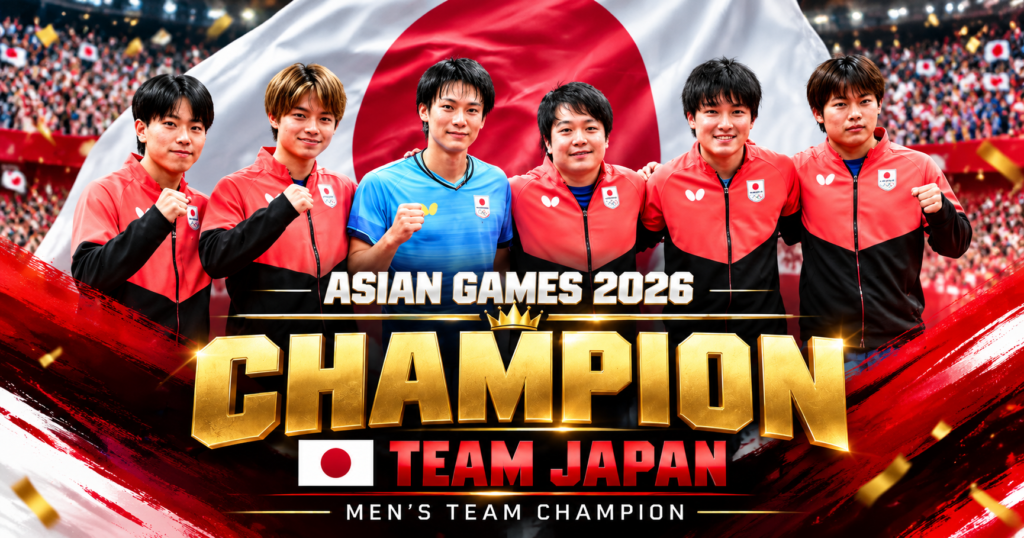
Later that day, Japan defeated China 3–2 in the men’s team table-tennis final at Sky Hall Toyota. The Olympic Council of Asia reported that Sora Matsushima won the decisive fifth match against Wen Ruibo 3–1, handing Japan its first Asian Games men’s team gold since Bangkok 1966.
Japan’s Tomokazu Harimoto played a pivotal role, defeating both Wen and world number one Wang Chuqin. The result ended China’s run of eight consecutive men’s team titles at the Asian Games, dating from the 1994 Hiroshima Games.
VnExpress, using Reuters imagery, described the win as Japan’s first Asian Games men’s team-table-tennis gold in 60 years and the end of China’s long-standing dominance in the event.
A medal should not become propaganda
China’s defeat does not diminish Tuergong’s gold. If anything, it makes the day’s contrast clearer: competitive sport can produce genuine, unpredictable achievement, whereas authoritarian governments seek to control the story around it.
Tuergong’s 64.26m throw deserves recognition as a remarkable Uyghur sporting victory. Yet Beijing should not be allowed to turn his success into a shield against criticism. Real respect for Uyghur athletes requires respect for Uyghur people including the freedom to preserve their identity, religion, language, families and dignity without fear of state punishment.