

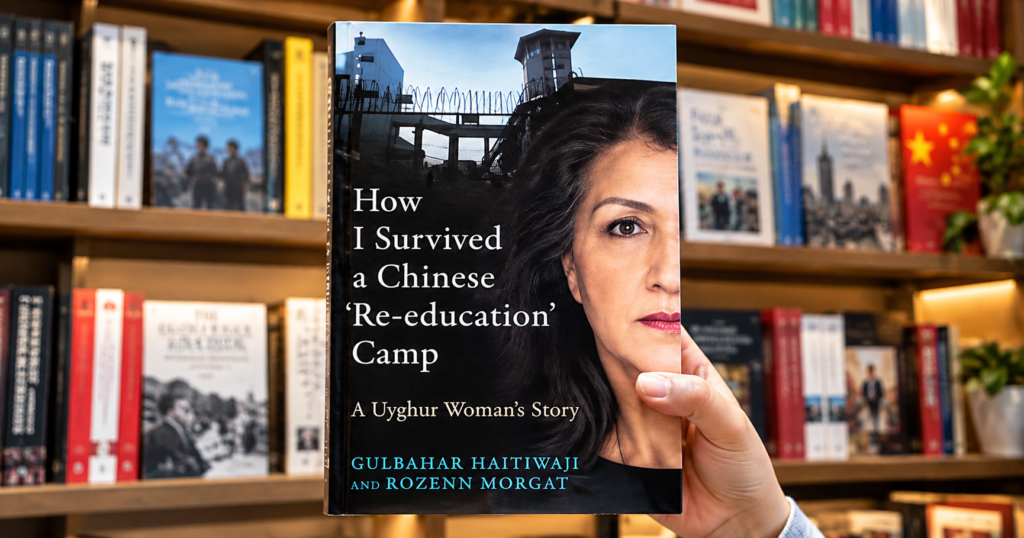
A routine phone call about retirement paperwork pulled Gulbahar Haitiwaji, a Uyghur engineer living safely in France, back to Xinjiang and into nearly three years of detention. She was held without a fair process, and her passport was taken. Her daughter’s campaign and French diplomatic pressure helped bring her home in 2019. She then wrote How I Survived a Chinese “Reeducation” Camp, which the Oslo Freedom Forum describes as the first memoir of the camps by a Uyghur woman.
Her story matters because China denies the system she describes. The Chinese embassy in France told AFP that “the so-called ‘re-education’ doesn’t exist”. Her testimony, and that of other survivors, says otherwise.
What happened to her
Haitiwaji worked as an engineer in the Uyghur region before moving to France with her two daughters to join her husband, who had sought asylum. In 2016, she returned to China to settle an administrative matter. According to the Oslo Freedom Forum, she was then detained, and she endured years of interrogation, hunger and brainwashing.
Bitter Winter reported that she disappeared on January 29, 2017, and that the family later learned she had been sentenced to seven years. During interrogation, a photograph of her daughter at a Paris demonstration for Uyghurs was used against her.
Her losses and struggles
In testimony to the U.S. House Select Committee, she described being hooded, shackled and chained to a bed for about 20 days. The China Project reported that she also described freezing conditions and injections of unknown drugs. These are her allegations, and Beijing rejects accusations of abuse.
Freedom came at a price. The Uyghur Tribunal transcript records that she was released in March 2019 after accepting all the charges against her. She lost years with her family, and her health suffered.
The Uyghur family that refused silence
Her daughter Gulhumar became the face of the campaign for her release. Bitter Winter reported that she launched a petition that drew more than 436,000 signatures. Bitter Winter Index on Censorship noted that Gulhumar and her father campaigned relentlessly, and that France lobbied for the release.
Her book and achievements
Haitiwaji wrote the memoir with French journalist Rozenn Morgat. Kirkus Reviews called it “a taut, moving, powerful account” of an ongoing human-rights disaster. Kirkus Reviews The Oslo Freedom Forum says the book has been translated into English and 12 other languages.
International appearances
- She gave evidence to the Uyghur Tribunal in London in 2021.
- She testified before the U.S. House Select Committee on March 23, 2023.
- NPR interviewed her about the memoir in 2022.
- She joined a conversation with Elisha Wiesel, supported by the Elie Wiesel Foundation.
Her influence on the oppressed and the young
Haitiwaji shows that survivors can speak even when threatened. She told AFP that China made a mistake by pursuing Uyghurs abroad, and that her aim is to see the camps closed. For oppressed communities, that message says silence protects the persecutor, not the victim. She is not alone in carrying this message to international stages. At the 17th Annual Geneva Summit for Human Rights and Democracy on February 18, 2025, Uyghur advocate Rahima Mahmut spoke in a session titled “The Campaign to Stop China’s Destruction of the Uyghurs”, and the summit’s official records list her as a featured speaker on Uyghur persecution. Together, voices like theirs show young Uyghurs and other oppressed communities that testimony, in books and at global forums, can keep pressure on Beijing and keep the world from looking away.