

The East Turkistan Government-in-Exile (ETGE) used China’s hosting of the 2026 APEC summit in Shenzhen to renew demands for international action over the treatment of Uyghurs and other Turkic Muslim communities. In a statement dated November 18, the organisation urged participating leaders to raise allegations of genocide, detention, forced labour and cultural repression directly with Chinese President Xi Jinping.
The ETGE called for targeted sanctions, stricter forced-labour trade controls, protection of diaspora communities and international support for East Turkistan’s independence. Its appeal was reported by ANI on November 19 as APEC leaders met to discuss economic cooperation and regional prosperity.
The intervention drew attention to human-rights concerns previously examined by the United Nations. However, the ETGE’s political demands, the UN’s findings and any diplomatic action taken by APEC governments must be assessed separately.
This interactive investigation examines the appeal, the evidence behind international scrutiny and the unresolved question of accountability.
Investigative Analysis / APEC 2026 / Uyghur Rights
Uyghur Rights at APEC 2026: ETGE Challenges Beijing Over Repression and Independence
As leaders met in Shenzhen to discuss regional prosperity, an exiled Uyghur political organisation sought sanctions, greater scrutiny of China’s human-rights record and support for its independence campaign.
01 / Diplomatic context
Two different agendas in Shenzhen
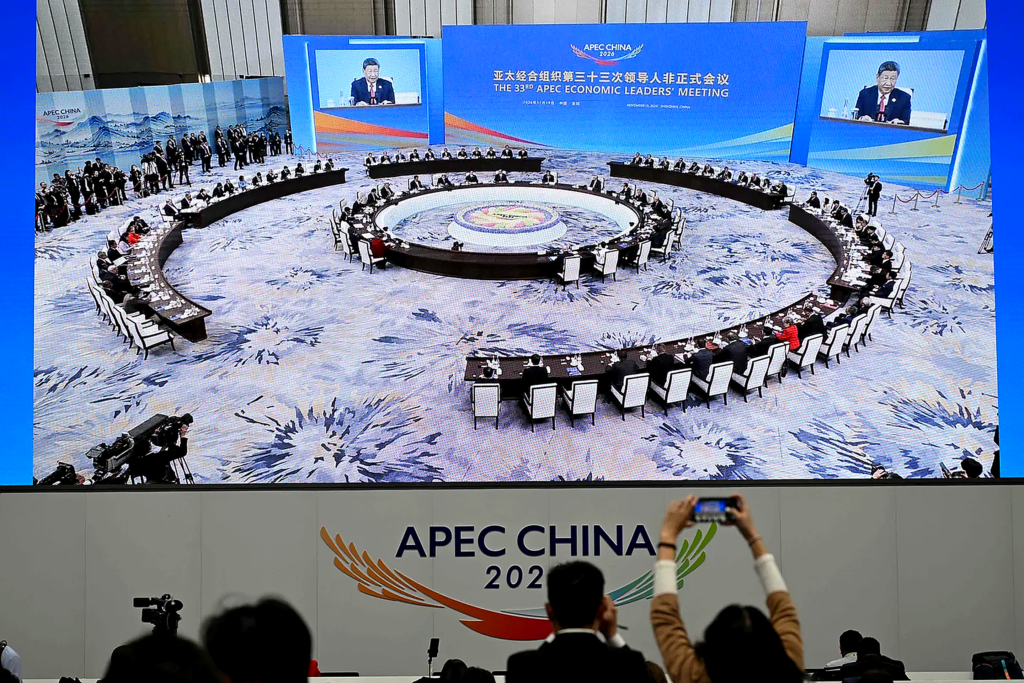
China hosted the 33rd APEC Economic Leaders’ Meeting in Shenzhen on November 18–19, 2026, under the theme of building an Asia-Pacific community for shared prosperity. The summit focused on trade, technology, economic development and regional cooperation.
Against that background, the East Turkistan Government-in-Exile issued a statement from Washington, DC, dated November 18. It urged participating governments to confront President Xi Jinping over allegations of genocide, arbitrary detention, forced labour and repression of Uyghur culture and religion.
Asian News International reported the appeal on November 19. The organisation asked governments to move beyond expressions of concern by imposing targeted sanctions, strengthening trade controls and protecting Uyghur communities outside China.
Its demands also included a distinct political objective: international support for East Turkistan’s decolonisation and restored independence. The ETGE regards the territory governed by China as the Xinjiang Uyghur Autonomous Region as a country under occupation. Beijing rejects this characterisation and considers Xinjiang part of China.
The APEC summit
Economic leaders met in Shenzhen under China’s chairmanship.
ETGE statement
The exiled organisation published its demands for accountability and independence.
International reporting
ANI reported the ETGE appeal while leaders were meeting in Shenzhen.
UN assessment
Earlier UN documentation provides important context, but is not the same as the ETGE’s political declaration.
These developments illustrate how a summit focused on economic integration can also become a focal point for demands about human rights and national identity.
02 / Interactive demands explorer
What did the ETGE ask APEC governments to do?
The ETGE statement set out six areas of action. Choose a proposal to examine its meaning and the distinction between a demand and an adopted policy.
Select a demand
Raise human-rights allegations with Xi Jinping
The ETGE urged leaders to demand releases of arbitrarily detained people, information about missing persons, family reunification and independent access to the region. The statement also requested transparency about leaders’ demands and Beijing’s responses. These are the organisation’s requests, not verified summit commitments.
Read the complete six-point agenda without JavaScript
Confrontation and humanitarian measures: Raise detention, disappearances, family reunification and access for independent investigators directly with Chinese authorities.
Targeted sanctions: Apply evidence-based restrictions to responsible officials and organisations, including further scrutiny of the Xinjiang Production and Construction Corps.
Forced-labour controls: Strengthen import restrictions and supply-chain enforcement against goods connected with coercive labour.
Diaspora protection: Address intimidation abroad and prevent returns that could expose people to persecution.
International accountability: Preserve evidence and seek legally appropriate investigations and accountability mechanisms.
Self-determination: Support the ETGE’s campaign for decolonisation and the restoration of East Turkistan’s independence.
03 / Interactive chronology
From international scrutiny to the Shenzhen appeal
United States announces a genocide determination
The US government determines that China has committed genocide and crimes against humanity against Uyghurs and other predominantly Muslim minority groups. This is a government determination, not an international judicial judgment.
UN Human Rights Office publishes Xinjiang assessment
The assessment concludes that the extent of arbitrary and discriminatory detention in the context of wider restrictions may constitute international crimes, particularly crimes against humanity.
ETGE reports submitting a decolonisation petition
The ETGE and East Turkistan National Movement say they submitted a petition to the UN Special Committee on Decolonization seeking recognition of the territory as a Non-Self-Governing Territory. Submission does not mean the UN adopted the request.
ETGE issues its six-point appeal
The organisation’s original press release calls for sanctions, trade enforcement, diaspora protection, independent investigations and recognition of its independence campaign.
ANI reports the appeal as leaders meet
International coverage brings attention to the ETGE’s demands. The leaders’ meeting concludes with the Shenzhen Outlook, a collective statement focused on economic cooperation and related policy priorities.
04 / Evidence and human-rights concerns
What does the international record establish?
International scrutiny of Xinjiang predates the 2026 APEC summit. The UN Human Rights Office’s August 2022 assessment examined detention, legal procedures, religion, cultural identity, privacy and family separation among Uyghurs and other predominantly Muslim communities.
The assessment concluded that extensive arbitrary and discriminatory detention, alongside broader restrictions on fundamental rights, may constitute international crimes, particularly crimes against humanity.
That finding is significant but should not be described as a judicial conviction. Nor did the assessment itself make a genocide determination equivalent to the US government’s 2021 determination.
China rejects accusations of genocide and systematic repression, describing its policies as necessary for counterterrorism, social stability, development and the protection of ethnic unity.
Established: What did the UN conclude?
The UN identified serious human-rights concerns and concluded that the extent of arbitrary and discriminatory detention may amount to international crimes, particularly crimes against humanity. This language preserves the report’s precise degree of legal certainty.
Attributed: What does the ETGE claim?
The ETGE alleges continuing genocide and colonial occupation and argues that restored independence is essential to lasting protection. These are its political and legal claims, rather than determinations accepted by all international institutions.
Official position: How does China respond to Xinjiang accusations?
China denies genocide and forced-labour allegations, insists that Xinjiang is an integral part of the country, and maintains that its development, security and employment programmes are legitimate.
05 / Trade and labour rights
Can open trade coexist with stricter forced-labour controls?
The economic agenda at APEC emphasised openness, resilient supply chains, innovation and regional development. The ETGE argued that the pursuit of commercial agreements should not prevent governments from investigating serious allegations involving workers in Xinjiang.
This creates a practical policy question for importing economies. A complex supply chain can include raw materials, processors and intermediaries in several jurisdictions. Identifying whether forced labour contributed to a particular product often requires tracing beyond the final assembly factory.
The ETGE called for stronger enforcement against goods linked to coercive labour and for scrutiny of financial and technology networks allegedly associated with repression.
Implementing such measures would depend on each government’s laws, evidentiary thresholds and trade-enforcement mechanisms. An ETGE proposal does not create a new APEC import prohibition.
Traceability
Identify the origins of materials and components, not merely direct suppliers.
Worker protection
Investigate whether employment is voluntary and whether workers can leave without punishment.
Trade enforcement
Apply restrictions where the relevant legal requirements are satisfied.
Independent scrutiny
Assess company claims against credible records, research and worker testimony.
06 / Beyond China’s borders
The issue of transnational repression
The ETGE also urged governments to protect Uyghur communities overseas. Its appeal referred to intimidation, surveillance, pressure involving relatives and the threat of forced returns.
Human-rights reporting has documented allegations that members of the Uyghur diaspora experienced coercion or pressure linked to their families in China. These practices can affect whether people feel able to protest, speak publicly or participate in community organisations.
The ETGE asked participating governments to strengthen safeguards against transnational repression and uphold protection against return to persecution.
The distinction between a reported threat and a legally established incident remains important. Authorities must investigate specific allegations, assess risks and protect affected individuals without treating Chinese ethnicity or ordinary community relationships as evidence of wrongdoing.
07 / The independence question
What does the ETGE’s UN petition actually mean?
The ETGE’s appeal went beyond human-rights protections to a demand for recognition of East Turkistan as a separate political entity entitled to restored independence.
The organisation says it and the East Turkistan National Movement submitted a petition in May 2026 to the UN Special Committee on Decolonization, commonly known as the C-24. It seeks the territory’s inscription as a Non-Self-Governing Territory.
The petition’s submission is a political and procedural development. It is not proof that the UN has accepted the ETGE’s territorial characterisation, recognised a government-in-exile or changed the region’s international legal status.
Beijing maintains that Xinjiang is an integral part of China and opposes separation. The competing positions involve contested historical interpretations, questions of self-determination and significant diplomatic obstacles.
| Question | What is established | What is not established |
|---|---|---|
| Petition | ETGE reports a May 2026 submission | UN acceptance of the territorial request |
| Independence | ETGE openly advocates restored sovereignty | International recognition of the ETGE as a state government |
| UN human rights | OHCHR published serious concerns in 2022 | A UN decision granting independence |
| China’s position | Beijing asserts Chinese sovereignty over Xinjiang | Agreement between the competing political positions |
08 / What followed?
Did APEC adopt the ETGE’s proposals?
The 2026 APEC Leaders’ Shenzhen Outlook addressed economic cooperation, technology, regional prosperity and employment. It included language supporting decent employment and workers’ rights.
However, the collective declaration did not establish adoption of the ETGE’s specific demands for East Turkistan independence, Xinjiang-related sanctions or a new forced-labour enforcement mechanism.
Nor does the existence of the ETGE statement prove that any particular APEC leader raised its demands with Xi Jinping. Establishing whether such discussions occurred requires attributable statements, official meeting records or reliable contemporaneous reporting.
Read the 2026 Shenzhen Outlook to compare the summit’s published commitments with the ETGE’s requests.
09 / Conclusion
Human rights and the limits of economic diplomacy
The ETGE’s intervention during APEC 2026 connected serious human-rights allegations with economic cooperation and a separate campaign for political independence. Its statement asked governments to consider sanctions, trade restrictions, diaspora protection and international recognition of East Turkistan’s independence claims.
These proposals received international reporting, but their publication should not be confused with adoption by APEC. The collective summit declaration focused on economic and development priorities, including general commitments concerning decent work.
The UN’s earlier assessment provides a substantial independent basis for continued scrutiny of detention and other restrictions in Xinjiang. At the same time, the ETGE’s independence demands and China’s sovereignty position remain politically and legally contested.
The wider policy question is how governments can pursue trade and regional cooperation while examining credible human-rights evidence, maintaining lawful supply chains and providing protection for vulnerable people.
10 / Source desk
Primary records and reporting
- East Turkistan Government-in-Exile, November 18, 2026 — original six-point appeal and political demands.
- Asian News International, November 19, 2026 — contemporaneous report of the statement.
- Chinese Foreign Ministry, November 13, 2026 — official confirmation of summit dates and theme.
- APEC Leaders’ Shenzhen Outlook, November 19, 2026 — the meeting’s collective statement.
- UN Human Rights Office, August 31, 2022 — independent assessment of the human-rights situation in Xinjiang.
- ETGE anniversary statement, 2026 — the organisation’s account of its decolonisation campaign.