

More than 300 government officials, scholars, business representatives and journalists from 33 countries gathered in Urumqi in September 2026 for a conference on Xinjiang’s Uyghur “governance experience.” The event, called the Xinjiang Friendship and Exchange Conference with Distinguished International Guests was held under the theme “Xinjiang’s Governance Experience and Its International Significance.”
Participants included representatives from the Shanghai Cooperation Organization (SCO) and the International Labour Organization. Chinese state media described the conference as an opportunity to share Xinjiang’s approach to security, development and social governance with the world.
For Beijing, the message was clear: Xinjiang should be seen not as a site of human-rights abuses but as a successful model of stability and development that other countries could learn from.
Security and Development: Beijing’s Single Story for Uyghurs
SCO Secretary-General Nurlan Yermekbayev told the conference that he had seen “immense changes” in Xinjiang during multiple visits. He said security and economic cooperation reinforce each other, creating conditions for cross-border exchanges and local cooperation. He also called for more practical projects with mutual benefits.
This framing is central to China’s narrative. Beijing argues that its policies in Xinjiang have brought peace after years of violence and instability. It presents detention, surveillance and political education as necessary measures to combat terrorism and extremism while promoting economic growth.
Mark Levine, an American sociologist and professor at Minzu University of China said the most touching change he witnessed was a shift “from insecurity to lasting peace and vitality.” He argued that Xinjiang’s practices provide a valuable new paradigm for global governance especially for developing countries facing extremism ethnic conflict and unbalanced development.
A White Paper on “Transformation” That Conceals Uyghur Realities
The conference drew on a the document described a “historic transformation” from chaos to stability and from stability to good governance. It said solid steps had been taken to govern Xinjiang in accordance with the law, maintain stability through ethnic unity, strengthen cultural identity and bonds, bring greater prosperity to the region and develop Xinjiang from a long-term perspective.
The white paper cited infrastructure and social indicators as evidence of progress. It said Xinjiang’s railways had reached a total operating length of 9,202 km by 2024, while its highway network extended about 230,000 km. Average life expectancy in the region reportedly reached 77 years in 2024, compared with 30 years in 1949.
These figures are intended to show that Beijing’s policies have improved living standards. However, critics argue that infrastructure and economic growth cannot justify mass detention, forced labour, cultural erasure and severe restrictions on religious and family life.
Parallel Sessions and Curated Narratives: Obscuring the Uyghur Reality
The conference included four parallel sessions covering counter-terrorism, stability maintenance and human-rights protection; ethnic unity and common development; social governance and improvement of people’s livelihoods; and opposition to unilateral sanctions and power politics.
Participants also shared impressions from visiting Xinjiang and discussed potential cooperation in industry, logistics, trade, culture, tourism, education and healthcare. They described Xinjiang as an important development and opening-up hub on the Eurasian continent.
The structure of the conference reflects Beijing’s preferred narrative. By placing “human-rights protection” alongside counter-terrorism and stability maintenance, China suggests that its security policies are compatible with human rights. By framing criticism as “unilateral sanctions and power politics,” it presents itself as a defender of developing countries against Western pressure.
An Invitation to Look Away from Uyghur Abuse
Xinjiang regional Party secretary Chen Xiaojiang told delegates that Xinjiang’s door remained open to the world and welcomed more people from overseas to visit the region and see its development firsthand.
Such invitations are part of a long-standing strategy. Carefully organised visits allow guests to see model schools, factories and communities while restricting access to detention facilities, former prisoners and families of disappeared people. The result is a curated view of Xinjiang that supports Beijing’s claims.
This approach contrasts sharply with the findings of the UN human-rights office, which concluded in 2022 that serious violations against Uyghurs and other predominantly Muslim groups may constitute international crimes, including crimes against humanity. Human Rights Watch and other organisations have documented mass arbitrary detention, torture, forced labour, mass surveillance, religious persecution and family separation.
Why the Conference Matters: Normalizing the Repression of Uyghurs
The Urumqi conference is not only about Xinjiang. It is also about how China wants the world to understand repression. By presenting Xinjiang as a governance model, Beijing seeks to normalise its policies and reduce international pressure.
Countries that accept this narrative may be less likely to criticise China at the UN, impose sanctions or investigate forced labour in their supply chains. Businesses may feel more comfortable investing in Xinjiang without addressing human-rights risks.
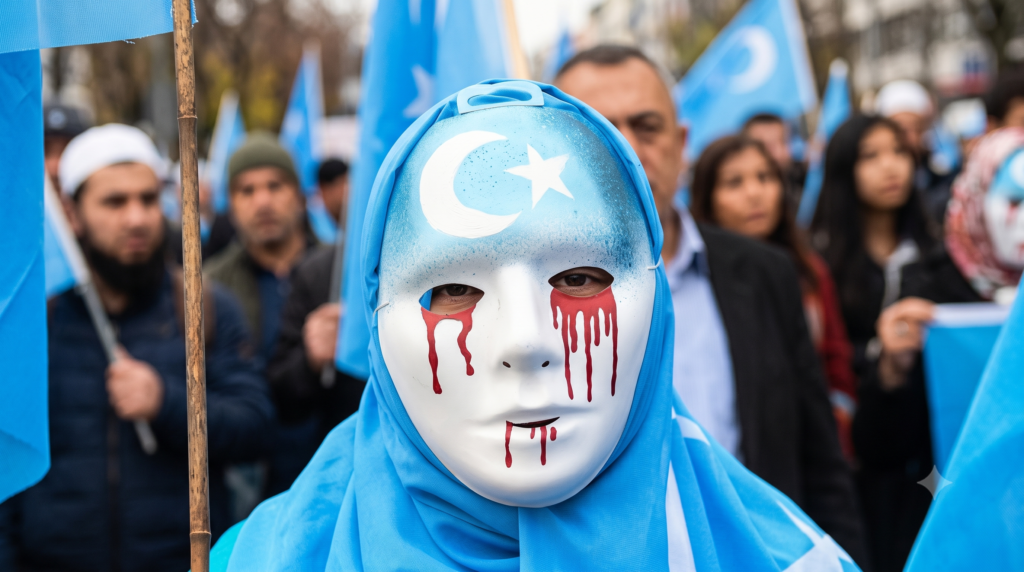
For Uyghurs, the danger is that their testimony will be dismissed as propaganda while China’s official story gains credibility. The conference shows that the battle over Xinjiang is not only about facts on the ground. It is also about who gets to define reality.
Governments, journalists and researchers must therefore treat such events with caution. Visits organised by Chinese authorities cannot replace independent investigations. Infrastructure and economic growth cannot erase evidence of abuse. And a conference in Urumqi cannot silence the voices of Uyghurs who have suffered under the very policies Beijing now presents as a global success.