
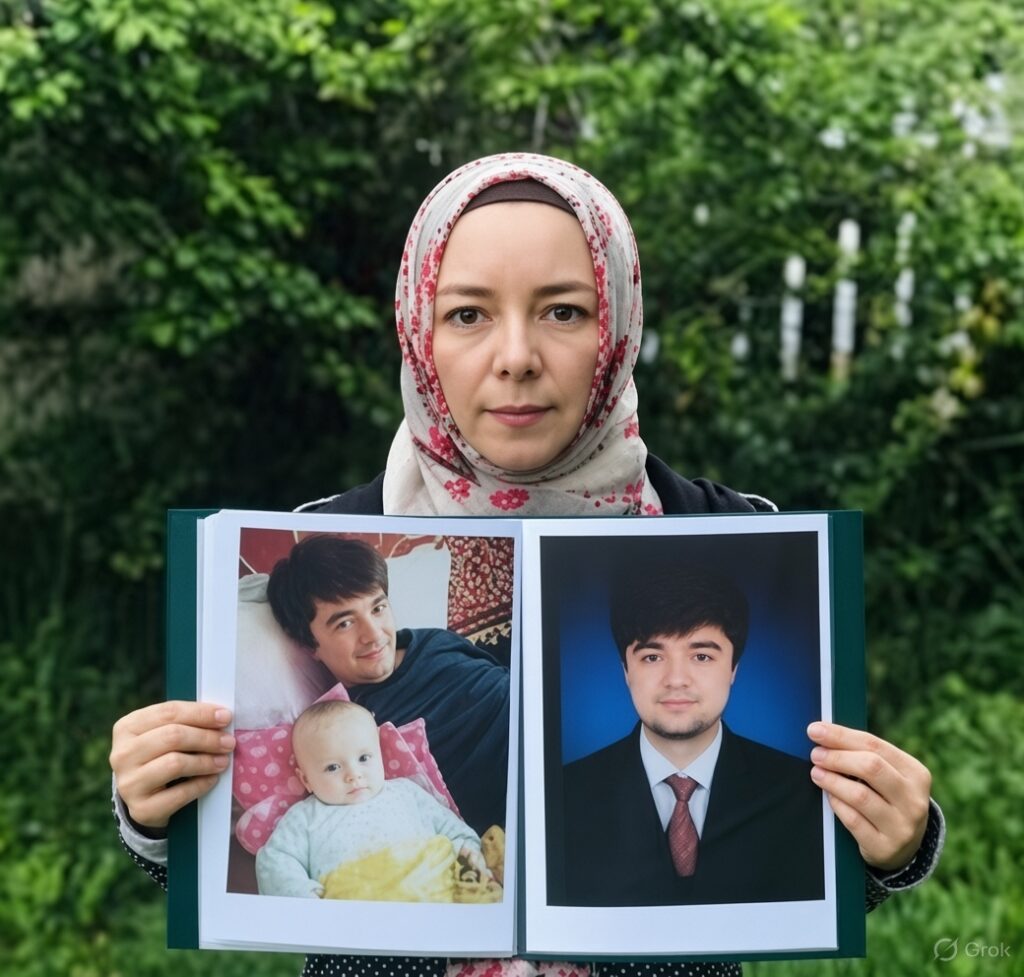
What happens when asking about your brother becomes an act of resistance? For Rizwangul NurMuhammad, a Uyghur human rights defender, the arbitrary detention of her brother Mewlan NurMuhammad became the reason to speak publicly. In an April 2026 profile the International Service for Human Rights (ISHR) describes how her family’s suffering pushed her into defending others facing oppression by Chinese authorities.
Her story opens a window onto something larger than one detention: how China’s security policies have damaged Uyghur family life restricted basic freedoms and extended fear beyond its borders. It also offers a different way to understand advocacy not simply as confrontation but as care.
A Uyghur Sister’s Search Becomes a Public Cause
Rizwangul’s activism grew from a deeply personal injustice. According to ISHR, her brother’s arbitrary detention drove her to campaign not only for her family, but for others whose relatives had suffered under Chinese authorities. Her demand for answers became a broader defence of human dignity.
Reporting by New Zealand’s 1News in August 2020 stated that Mewlan had received a nine-year prison sentence for “splitting the state.” China’s diplomatic representatives confirmed that he had been sentenced in August 2017 for what they called “separatist activities.” That historical reporting does not establish his present whereabouts or legal status.
The distinction matters. An official accusation is not, by itself proof that a prosecution respected human rights. Rizwangul’s story should be read alongside documented concerns about arbitrary detention and discriminatory security policies affecting Uyghurs.
How China’s Security Policies Harm Uyghur Life
Beijing presents its approach in Xinjiang as counterterrorism and “de-radicalization.” But the UN Human Rights Office’s August 2022 assessment found serious human rights violations against Uyghurs and other predominantly Muslim communities. It concluded that arbitrary and discriminatory detention alongside wider rights restrictions, “may constitute international crimes in particular crimes against humanity.” This was a UN assessment not a criminal court judgment.
The damage described was not limited to detention facilities. The assessment identified far-reaching restrictions on religious freedom, privacy and movement. Independent UN experts also highlighted limitations on cultural life, language, expression and family life. Together, these restrictions reach into the ordinary activities through which people maintain identity and belonging.
Surveillance adds another layer of control. The UN assessment described allegations of intensive monitoring accompanying counterterrorism policies. Its wider findings suggest that repression must be understood as a system: detention, intrusive scrutiny and restrictions on everyday freedoms can reinforce one another rather than operate separately.
Uyghur Families Face Harm Beyond China’s Borders
Leaving China does not necessarily end the consequences. The UN found that government policies had “transcended borders,” separating families, severing contact and producing patterns of intimidation and threats against diaspora members who spoke publicly. For families abroad, distance can therefore coexist with continuing vulnerability.
This reveals an often-overlooked cost of repression: uncertainty itself becomes part of the harm. When relatives cannot safely communicate or obtain reliable information, family relationships are placed under pressure. The UN’s call for accurate detention information and safe communication channels recognises that knowing where someone is—and whether they are safe—is a basic human need.
Rizwangul’s words challenge the idea that advocacy is only political opposition: “Speaking up is not only an act of resistance, but it is also an act of care and love for our kin.” Her framing restores the family relationship behind the public campaign.
What Accountability Should Mean for Uyghur Families
China rejects allegations of discrimination and says its counterterrorism measures follow the rule of law. Those denials do not resolve the documented concerns. The UN recommended releasing arbitrarily detained people, clarifying detainees’ whereabouts, enabling family reunification and reviewing security legislation against international human rights standards.
For Uyghur families, these are concrete demands: information, contact, freedom and accountability. Rizwangul’s story leaves a question that reaches beyond one country: what does security mean if families must sacrifice their most basic bonds to it? Her answer begins with refusing to let love be silenced.