

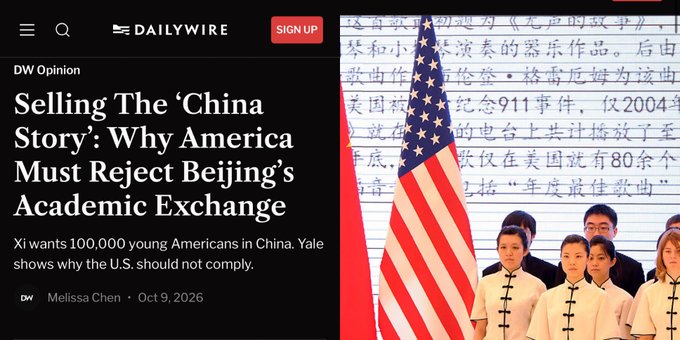
Is China investing in American education or cultivating relationships with America’s future decision-makers? Xi Jinping’s invitation for 100,000 young Americans to visit China over five years deserves scrutiny beyond the language of friendship. Announced during his September visit to Washington, the initiative could connect students with institutions whose relationships may outlast their studies. Some participants may become officials, researchers or business leaders. Meanwhile, American scholar Min Zin remains detained after travelling to China for an academic conference. Washington has designated his detention wrongful. Together, the invitation and detention raise a question for universities: how can they preserve educational opportunity without overlooking Beijing’s capacity to build influence, restrict freedom or target individuals? The answer requires safeguards, not an assumption that every exchange is harmless or every participant becomes compromised.
Relationships That Outlast the Classroom
International education is a tool of soft power: influence built through attraction, familiarity and relationships rather than force. China is not alone in using it. Universities worldwide educate people who later shape their countries’ political and economic decisions.
For Beijing, long-term connections can create opportunities to explain its positions, build institutional partnerships and gain access to influential networks. Research on China’s education policies identify global influence and elite relationships as strategic objectives. That does not mean students automatically adopt government views.
The concern is not friendship with Chinese people. It is whether state-linked institutions seek privileged influence over people who may later make sensitive decisions. Claims about students acquiring Chinese citizenship should not be included without evidence connecting nationalization to this programme.
When Cultivation Becomes Recruitment
Intelligence recruitment is distinct from cultural influence. A documented case shows why universities should nevertheless prepare students for it.
Glenn Duffie Shriver studied in Shanghai and returned after graduation. Chinese intelligence officers cultivated him and encouraged him to seek U.S. government employment. He admitted that his objective was to obtain classified information and provide it for money. He pleaded guilty and received a four-year prison sentence
The FBI warns that students’ language abilities and career prospects can make them attractive recruitment targets. Shriver’s case establishes a recruitment risk, not evidence that Xi’s entire initiative is an espionage operation. Studying in China does not make an American student a spy.
An Invitation Is Not a Guarantee
Min Zin’s detention exposes another vulnerability. NPR reported that the Myanmar-focused scholar was detained upon arrival in Kunming on 3 June after receiving an academic invitation. China accused him of espionage and endangering national security. The United States later designated him wrongfully detained
His experience does not predict every visitor’s treatment. It does undermine the idea that institutional sponsorship guarantees safety.
The State Department warns about arbitrary law enforcement, wrongful detention and exit bans in China. Universities must explain these risks before encouraging participation.
Engagement Must Have Boundaries
Rejecting all exchanges could also reduce America’s understanding of China. Firsthand knowledge can strengthen diplomacy and help future officials challenge misleading claims. Some analysts warn that declining participation risks leaving America without enough China expertise.
The answer is informed engagement: transparent funding, independent academic access, research-security briefings, confidential reporting channels and emergency plans. Students should recognise requests for sensitive information and disclose inappropriate approaches.
Beijing’s invitation should be judged by protections, not participation targets. Educational cooperation deserves support when it expands understanding freely. It deserves scrutiny when access becomes leverage, relationships conceal intelligence approaches or visitors cannot leave. America should cultivate expertise without surrendering judgment.