
The East Turkistan Government in Exile (ETGE) marked its 22nd anniversary on 14 September 2026, by renewing its call for the Uyghur independence and sovereignty of East Turkistan. The organisation’s president, Dr. Mamtimin Ala, said the ETGE would continue representing the political aspirations of Uyghurs, Kazakhs and other East Turkistani peoples before governments, international institutions and courts.
The anniversary was not simply a commemorative event. It was an attempt to keep East Turkistan’s political status and the Uyghur question on the international agenda at a time when China is presenting Xinjiang as a successful model of stability, development and governance.
For the ETGE, however, the central issue is not regional development. It is the right of the people of East Turkistan to determine their own political future.
Founded to Restore the Uyghur Political Voice
The ETGE was established in Washington, D.C., on 14 September 2004. According to Dr. Ala’s statement, Uyghur, Kazakh and other East Turkistani leaders created the organisation to restore the region’s political voice, preserve the continuity of its statehood and defend the right to national self-determination and independence.
The ETGE describes itself as the political successor to earlier East Turkistan republics. It argues that the region was forcibly incorporated into the People’s Republic of China in 1949 and that its people have since experienced foreign rule and systematic political subordination.
China rejects this description. Beijing considers Xinjiang an inseparable part of China and refers to the region as the Xinjiang Uyghur Autonomous Region. Chinese authorities say their policies have brought economic growth, public security and social stability.
The dispute is therefore not only about present-day human-rights abuses. It also concerns history, sovereignty and whether the people of East Turkistan possess a separate political identity.
Allegations of Uyghur Repression and Forced Assimilation
Dr. Ala accused China of carrying out decades of repression involving mass detention, forced assimilation, forced labour, population transfers and family separation. He also alleged the destruction of Uyghur and other Turkic people’s cultural, religious and political identity.
The UN human-rights office reported in 2022 that serious violations against Uyghurs and other predominantly Muslim groups may constitute international crimes, including crimes against humanity. The assessment documented arbitrary detention, torture allegations, intrusive surveillance and severe restrictions on religious and cultural life.
Human Rights Watch has also documented mass detention, forced labour, religious persecution, family separation and restrictions on Uyghur language and culture.
These findings form the basis of the ETGE’s argument that the international community must address the political causes of the crisis, not only its humanitarian consequences.
Uyghur Independence and the Inherent Right to Self-Determination
The ETGE says the people of East Turkistan have an inherent right to decide their political future. Its position goes beyond calls for cultural protection or regional autonomy. It demands independence, sovereignty and what it describes as the decolonisation of East Turkistan.
Not all Uyghurs or East Turkistani organisations support the same political solution. Some advocate independence, while others focus on human rights, genuine autonomy, religious freedom, language rights or democratic reform. These differences are important and should not be ignored.
However, peaceful calls for independence or self-determination should not automatically be treated as terrorism. Political disagreement must be addressed through debate, evidence and international law rather than collective punishment.
Taking the Uyghur issue to international institutions
Over the past 22 years, the ETGE says it has worked with governments, parliaments, international organisations and legal bodies to document abuses and present what it considers the historical and legal basis for East Turkistan’s right to self-determination.
Dr. Ala highlighted May 2026, when the organisation submitted what it called the first petition on the national question of East Turkistan to the UN Special Committee on Decolonization. The petition reportedly raised questions about the region’s political status, China’s rule and the right of its people to decolonisation and independence.
This move seeks to shift international discussion away from viewing Xinjiang only as a domestic Chinese security issue. The ETGE wants governments and the UN to examine the question through the principles of self-determination and decolonisation.
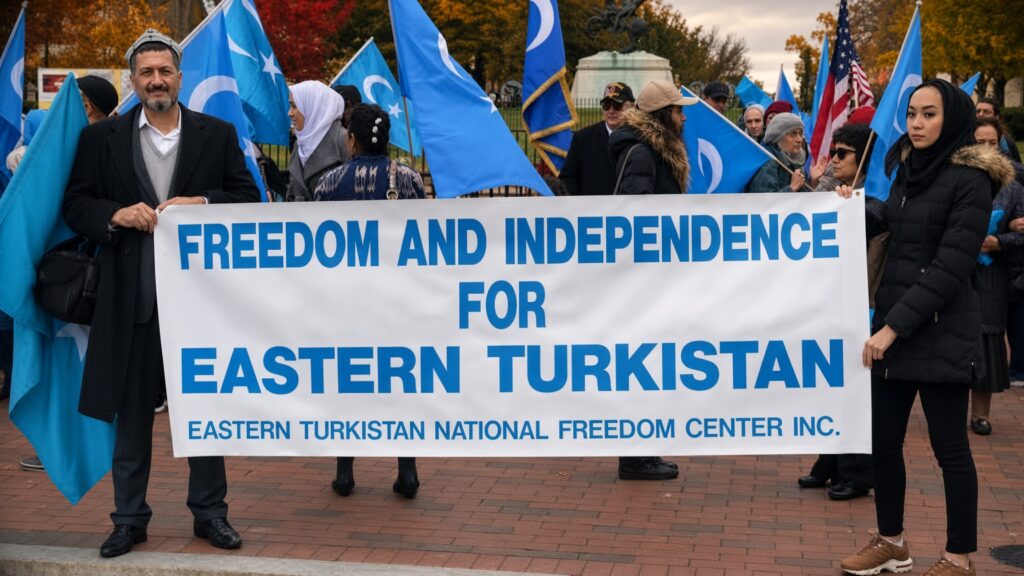
A Direct Message to the International Community on Uyghur Sovereignty
The ETGE called on states to support the right of East Turkistan’s people to determine their political future and to hold China accountable for alleged genocide and crimes against humanity. It also urged governments to address what it describes as the root cause of the crisis rather than only responding to its consequences.
China is unlikely to accept this argument. Beijing has consistently rejected accusations of genocide and says its Xinjiang policies are necessary to combat extremism and maintain stability.
Nevertheless, the ETGE’s anniversary demonstrates that political aspirations have not disappeared. The organisation’s message is that development cannot replace freedom and infrastructure cannot erase national identity.
For its supporters, East Turkistan’s sovereignty is not a concession to be granted by China or another power. It is an inherent right. The ETGE says it will continue pursuing that goal through diplomatic and political channels until East Turkistan becomes, in its words, a free, independent and sovereign nation.