

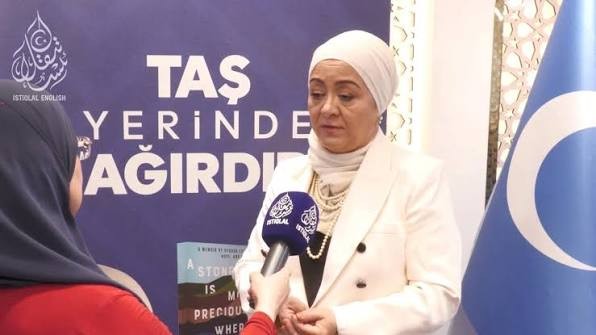
“When the truth is buried, the greatest act of courage is to keep speaking.” That idea defines the remarkable journey of Gulchehra Hoja, a Uyghur-American journalist whose life has become a symbol of resilience, sacrifice and unwavering commitment to truth. At a time when information can be controlled and history rewritten; her voice continues to ensure that the stories of the Uyghur people are not forgotten.
International media have recognized both her courage and the significance of her work. CBC described her memoir as a powerful reflection on exile, identity and survival, while The Christian Science Monitor highlighted her efforts to preserve the memory and culture of a people facing profound challenges. Together, these accounts portray a journalist who has transformed personal loss into a mission to inform the world.
Born in 1973 in Ürümqi, in the region many Uyghurs call East Turkistan, Hoja developed a passion for storytelling from an early age. After studying Uyghur Language and Literature at Xinjiang Normal University, she became one of the first well-known Uyghur television presenters. As host of the first Uyghur-language children’s television program, she inspired young audiences and became a familiar face across the region.
Her success eventually led her to work with Chinese state media, including Xinjiang Television and China Central Television (CCTV). Although her career flourished, everything changed during a trip to Europe in 2001. There, she encountered independent reporting about the treatment of Uyghurs information she had never seen while working in China’s tightly controlled media environment.
The experience changed her life forever.
Unable to ignore what she had learned, Hoja chose not to return to her career in China. Instead, she moved to the United States and joined Radio Free Asia’s Uyghur Service in Washington, D.C. It was a life-changing decision that meant leaving behind her homeland, family and professional success in pursuit of something greater: the freedom to report the truth.
For more than two decades, Hoja has reported on issues affecting Uyghurs, including human rights, culture, education, religion, health and political repression. Her journalism has become an important source of information for the international community as independent reporting from the region has become increasingly difficult.
The personal cost of her work has been heartbreaking.
International reports indicate that around two dozen of her relatives, including her parents, were detained or disappeared in China. Many observers believe these actions were intended to pressure and silence her because of her reporting. Despite this immense personal tragedy, Hoja has refused to abandon her mission.
She has often spoken about the pain of knowing her loved ones have suffered because she chose to tell the truth. Yet she believes that remaining silent would only deepen the injustice experienced by countless Uyghur families whose stories deserve to be heard.
Her dedication has earned global recognition. In 2019, she received the Magnitsky Human Rights Award, followed by the International Women’s Media Foundation Courage in Journalism Award in 2020. She has also been listed among The 500 Most Influential Muslims, reflecting the international respect she has gained through years of courageous reporting.
Beyond journalism, Hoja is the author of the memoir A Stone Is Most Precious Where It Belongs, a deeply personal account of exile, identity and the meaning of home. More than a memoir, the book preserves memories, traditions and experiences that might otherwise disappear. Through her writing, she reminds readers that culture survives when people continue telling their stories.
Throughout her career, Hoja has shown that journalism is more than reporting events, it is an act of preserving truth and human dignity. Every interview, every investigation, and every published story become a testament that future generations can look back on.
Gulchehra Hoja’s journey is one of extraordinary courage. She sacrificed comfort for conscience, accepted exile for freedom and transformed personal grief into a lifelong commitment to justice. Her work demonstrates that even when powerful forces attempt to silence a voice, truth can still cross borders and inspire the world.
Her greatest achievement is not simply the awards she has received or the headlines she has written. It is that, despite every effort to silence her, she continues to speak for those who cannot.