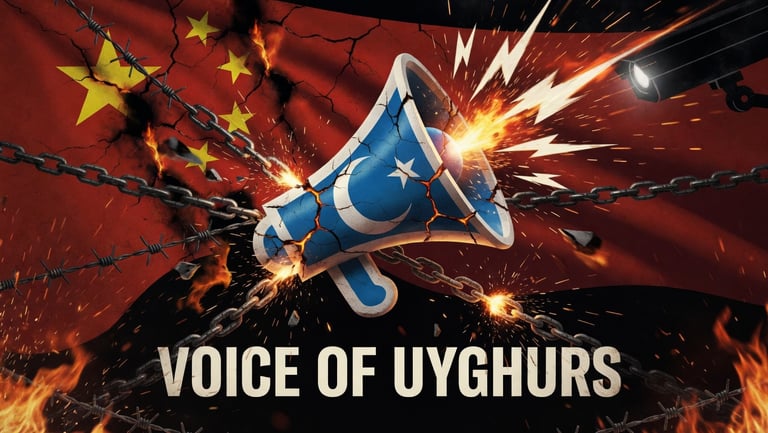
Made in Detention
How Uyghur Forced Labour Is Stitched Into the World’s Supply Chains
6/22/2026
A System Built on Coercion
Gulzira Auelhan, a Kazakh woman was let go from a detention center in Xinjiang in 2018, only to learn she had to follow rules after leaving. Her freedom came with limits placed upon it. What happened next seemed more like control than liberty. Once out, movement and contact fell under scrutiny. She was given a one-year labor contract and moved to a glove factory in the Ili prefecture. The conditions could not be changed. She was informed that refusing meant going back to jail. She pledged.
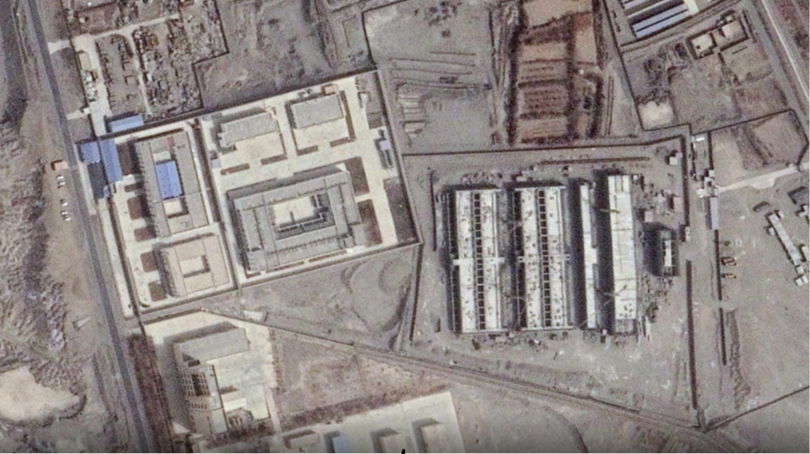
Gulzira's story is not an anomaly. It depicts the layout of a system that, since 2017, has subjected Uyghurs and other Turkic Muslim minorities in the Xinjiang Uyghur Autonomous Region to what scholars refer to as the largest system of state-imposed forced labor in the world. Through survivor testimony, satellite imagery, and leaked government records, what the Chinese government has presented as a program of "vocational training" and poverty alleviation has been shown to be much more coercive: the systematic extraction of labor from a population under duress.
The United Nations and several international human rights organizations have determined that over one million Uyghurs and other Turkic Muslims have been held in these centers without proper legal procedures. Within the facility, they faced compulsory ideological training, limitations on religious activities, and circumstances that ex-detainees consistently characterize as harsh. Work was essential to this process. It was essential to it.
Transferred, Confined and Far From Home
Outside the camps an additional mechanism broadened the system’s influence throughout China. The Australian Strategic Policy Institute has estimates that no fewer than 80,000 Uyghurs were relocated from Xinjiang and placed in factories across different provinces as part of a central government initiative. Workers were placed in a electronics assembly lines, textile units, and automotive component plants in nine provinces via this programme. Including in that group was Ahmetjan Mehmetimin a young Uyghur individual who started his employment at the Zhundong Coal Mine in 2017. Restricted from going out during the pandemic he remarked to coworkers: “How can I not long for it? "It has been three years since I celebrated Eid al-Adha with my family”. His phrase carries weight, not of catastrophe, yet of something lost - a gathering, shared food, rite. Absence marks what should have been moments of unity and prayer.
The circumstances for the workers sent outside of Xinjiang reveal additional proof that the coercion continues beyond the factory entrance. In a Quanzhou facility located in Fujian province, Uyghur employees reside in dormitories apart from Han coworkers, surrounded by iron gates and overseen by cameras. At the conclusion of every shift, officers who traveled with them from Xinjiang accompany them back, rather than local police. Their identification papers have been seized. They are, in any significant way, not allowed to depart.
A 2026 whistleblower report which featured in the sourcing journal WWD has offered unique operational insights from inside the enforcement framework. A Han Chinese police officer stationed in southern Xinjiang from 2014 to 2023 recounted overseeing forced labor assignments in cotton fields during two harvest seasons and personally delivering detainees to over fifty detention centers. He described the organized pressure imposed on those who tried to oppose: local committees possessed sole power over individuals, and noncompliance led to rigorous ideological indoctrination sessions or direct threats of re-arrest.
Woven Into Every Industry
The goods produced by this system does not reach international markets labeled as such. Xinjiang generates roughly 20 percent of the global cotton supply, and studies suggest that one in five cotton apparel items sold worldwide includes fiber sourced from this area. Polysilicon for solar panels, PVC in construction and medical tubing, aluminium in automobiles, tomato paste, and walnuts in food supply chains: all have been reported as products associated with forced labour instances. In 2024, Human Rights Watch expressed worries that General Motors, Tesla, Toyota, and Volkswagen might be obtaining aluminium linked to the forced labour system. The shift to clean energy and the worldwide fashion sector, both of which often emphasize ethical responsibilities, are among the most vulnerable.
Corporate exposure is not limited nor restricted to firms with direct activities in Xinjiang. The Uyghur Forced Labor Database has identified more than 2,000 multinational companies connected to the region through their supply chains. A 2025 investigation by the Bureau of Investigative Journalism identified over one hundred international brands. However, conventional due diligence has shown to be structurally insufficient. A KPMG survey revealed that 68 percent of companies focused their audits solely on their first and second tier suppliers, neglecting the further layers of their supply chains. Employees under state pressure cannot communicate openly with auditors. The outcome is a type of adherence that fulfills documentation obligations while allowing the fundamental circumstances to remain unchanged.
Accountability in the Age of Complicity
Laws have started enforcing stricter accountability. In December 2021, the United States passed the Uyghur Forced Labor Prevention Act, creating a legal assumption that products made in the area or by designated organizations involve forced labor and cannot be imported. By 2025, 144 companies from China were listed on the entity list. High-ranking Chinese officials admitted during the National People’s Congress in March 2025 that these sanctions pose, as they said, one of the greatest obstacles to the development of the region. The Corporate Sustainability Due Diligence Directive of the European Union, enacted in 2024 and effective from 2026, will mandate that large corporations tackle human rights abuses within their supply chains, holding them legally accountable for violations.
These advancements are most important. They are not adequate yet. In 2025, Xinjiang’s textile industry reportedly generated almost 47,000 new employment opportunities, while yarn production increased by more than 20 percent compared to the previous year. A study released in July 2025 reported a swift increase in air cargo connections linking Urumqi with European cities, establishing new pathways for regional goods to access global markets. The trade infrastructure has evolved more quickly than the accountability infrastructure.
At the heart of this matter is not a concept. It is Gulzira, sewing gloves in a factory she didn't select. Ahmetjan is reflecting on the years that have passed since he celebrated Eid with his family. Rebiya Memet, a young woman in her early twenties, is seen in a photograph testing chemicals at a government-owned facility in Urumqi, where she was relocated as part of a compulsory program that mandated her to pledge gratitude to both the company and the government responsible for her placement.
The clothing, sections, and parts that show no sign of these individuals have still been handled by them. Closing that gap requires strict supply chain transparency, effective law enforcement, and a dedication to considering due diligence as a real responsibility instead of a mere procedural formality, which will be one of the more urgent challenges for governments and corporations in the future. In simple terms, it's also about being honest regarding the expenses involved in producing the items we purchase.
Small actions create meaningful lasting change
Every tree planted, every volunteer hour, every donation brings us closer to a healthier planet.

EarthForward is a non-profit organization focused on practical climate action – from reforestation and coastal clean-ups to sustainability education for youth and communities.
Subscribe to Our Newsletter
Navigation:
General Inquiries:
Phone:
Adress: