

Leaked documents and international investigations expose the gap between Beijing’s claims and its treatment of Uyghurs in East Turkistan.
China calls its former detention camps vocational training centres. Leaked government documents describe locked facilities, constant surveillance and instructions to prevent escapes. That contradiction sits at the heart of Beijing’s global propaganda campaign over Xinjiang, known to many Uyghur advocates as East Turkistan: an effort to replace evidence of repression with images of normal life. Investigations have traced thousands of apparently personal videos to a coordinated information operation, while United Nations investigators have warned that abuses against Uyghurs and other predominantly Muslim minorities may constitute crimes against humanity. The issue is not whether China can produce reassuring footage. It is whether that footage answers the documentary record, survivor testimony and demands for independent scrutiny.
The strongest challenge to Beijing’s account comes from the government’s own paperwork. Published in 2019, the International Consortium of Investigative Journalists’ China Cables investigation exposed operational instructions for detention facilities and a surveillance system used to identify people for confinement. BBC Panorama reported that the documents described “locked, closely guarded indoctrination camps,” directly contradicting claims that attendance was voluntary. Instructions on secrecy and preventing escapes reveal control, not ordinary education.
These findings matter because official language can disguise coercion. Calling detainees students does not establish consent; describing confinement as training does not explain why people cannot leave. Beijing presents its policies as counter terrorism, development and poverty reduction. Yet the UN assessment identified concerns that broadly defined terrorism and extremism provisions could criminalise legitimate religious activity and other protected conduct. Security claims cannot substitute for evidence that detention was lawful, necessary and individually justified.
The legal conclusions require precision. In January 2021, the United States determined that China was committing genocide in Xinjiang. The UN human rights office used different language in August 2022, concluding that arbitrary and discriminatory detention, alongside broader restrictions on fundamental rights, “may constitute international crimes, in particular crimes against humanity.” It did not make a genocide determination. Keeping those assessments distinct strengthens scrutiny rather than weakening it: criticism loses authority when it claims more than investigators established.
Beijing’s response has extended beyond diplomatic denials. A joint New York Times and ProPublica investigation analysed more than 3,000 videos and found evidence of a government-orchestrated influence campaign. The clips featured residents denying abuses and attacking foreign critics. Many first appeared on Pomegranate Cloud, a regional Communist Party news application, before reaching YouTube and other international platforms with English subtitles. What looked like spontaneous testimony followed an organised distribution pipeline.
On Twitter, the investigation identified more than 300 accounts whose posting patterns suggested coordinated activity rather than ordinary users independently sharing opinions. Chinese diplomats and state media then amplified the videos. This sequence matters: an official narrative can appear more persuasive when audiences encounter it through seemingly unrelated voices. Repetition creates familiarity, but familiarity is not verification. Thousands of similar statements cannot independently resolve evidence of detention merely because they circulate widely.
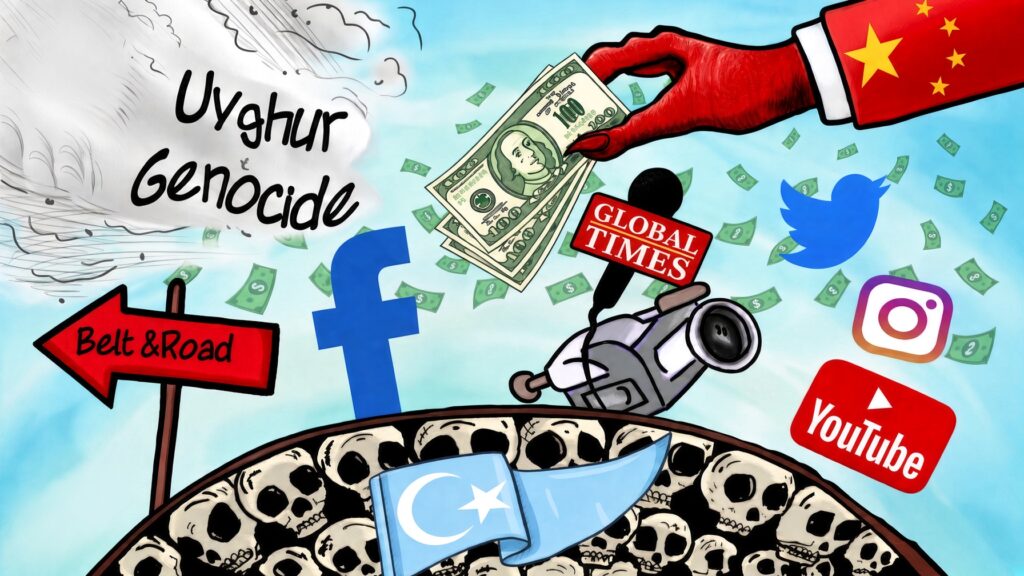
A September 2022 US State Department report described a wider campaign involving multilingual media, diplomatic messaging, inauthentic accounts and foreign influencers. Its findings should be attributed to Washington, not presented as a politically neutral verdict. Nevertheless, the independently documented video operation supports the central concern: Beijing has deployed substantial communications machinery to reshape overseas perceptions. The sources cited here do not establish a reliable total budget for that effort, so claims about its financial cost require caution.
The real test is accountability. A government seeking to rebut allegations should answer specific findings, disclose detention records and enable scrutiny that protects witnesses from reprisals. Promotional footage cannot do that work. The UN assessment drew on official documentation, other evidence and forty detailed interviews, not simply hostile political rhetoric. Until China addresses that record substantively, its campaign offers audiences a preferred image without resolving the abuses behind it. The people affected deserve answers about their rights, freedom and families, not another carefully distributed denial.