
On 31 August 2022, the Office of the United Nations High Commissioner for Human Rights (OHCHR), under then-High Commissioner Michelle Bachelet, concluded that China’s treatment of Uyghurs and other predominantly Muslim communities in Xinjiang “may constitute international crimes, in particular crimes against humanity.” By then, investigations by the BBC, Reuters, The New York Times, The Guardian, Human Rights Watch, and Amnesty International had documented a pattern of mass arbitrary detention, pervasive surveillance, forced labor, family separation and severe restrictions on religious and cultural life. Yet, as international attention shifted to conflicts in Ukraine and the Middle East, the Uyghur crisis steadily receded from global headlines while the underlying policies remained in place. Against this backdrop, the 3rd International Uyghur Forum, held in Berlin from 11–13 June 2026, emerged as a renewed call for international action.
Jointly organized by the World Uyghur Congress (WUC) and the Uyghur Center for Democracy and Human Rights (UZDM), the forum brought together more than 200 participants from over 25 countries, including parliamentarians, legal experts, academics, journalists, human rights defenders, camp survivors and representatives of the Uyghur diaspora. Under the theme “Ten Years Since the Camps: From Recognition to Accountability What’s Next?”, discussions focused on closing the gap between international recognition and meaningful enforcement. Opening the forum, Dolkun Isa, President of the World Uyghur Congress, stressed that acknowledging atrocities is no longer sufficient and urged democratic governments to translate their commitments into concrete legal, diplomatic, and economic measures. Echoing that message, the forum declaration called for stronger enforcement against forced labor, greater protection for Uyghurs living abroad, targeted sanctions against perpetrators and coordinated international efforts to ensure accountability.
The forum’s significance, however, extended well beyond its formal agenda. According to the World Uyghur Congress, organizers encountered reported attempts to pressure hotels and conference venues into cancelling reservations, discourage service providers from cooperating, and intimidate those involved in hosting the event. These allegations reflect a broader pattern of transnational repression documented by Freedom House and Human Rights Watch, which have reported efforts by the Chinese government to monitor, intimidate and silence critics and Uyghur diaspora communities beyond its borders. For many participants, the risks were deeply personal. Although they now live in democratic countries, many still have parents, spouses, siblings or children in Xinjiang, leaving them with the constant fear that public advocacy could expose their loved ones to retaliation.
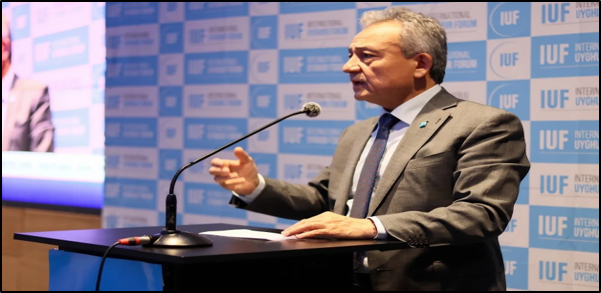
The author, Dolkun Isa, speaking at the Forum.
Despite these reported challenges, the 3rd International Uyghur Forum concluded successfully in Berlin, demonstrating that international solidarity has not been extinguished by intimidation. More than a three-day conference, it reaffirmed that protecting human rights also means protecting the freedom to speak, organize, and bear witness. By uniting survivors, scholars, policymakers, and civil society leaders, the forum transformed shared concern into a renewed commitment to action. Ultimately, it reinforced a central message: recognition is only the beginning. Without sustained international resolve, legal accountability and coordinated action, justice for the Uyghur people will remain an unfulfilled promise.