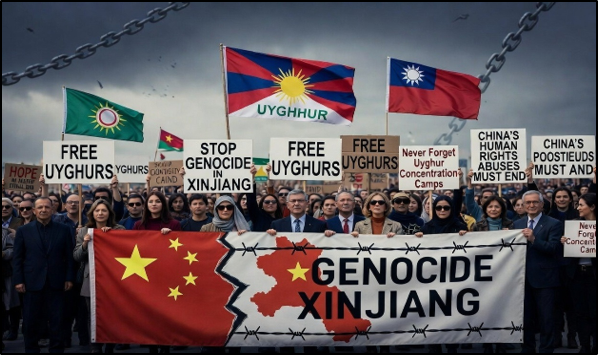
China’s brutal assault on Uyghur identity in Xinjiang traces back decades of calculated oppression, not sudden chaos. 18 March marks a stark reminder: this isn’t terrorism, but a desperate fight for survival against Beijing’s iron fist. From forced Han migration and mosque crackdowns since 1949, to the 2009 Ürümqi massacre and Xi’s 2014 terror war, the Communist Party has crushed every cry for freedom. Today’s camps holding over a million echo the 1926 Beijing bloodbath, proving China’s timeless playbook of violence endures. Demand justice now.
Roots of unrest
According to council on foreign relations.org, Uyghurs are a Turkic, mostly Muslim community native to Xinjiang, a region Beijing occupied after the Chinese Communist Party took power in 1949. Since then, the Chinese state has tried to absorb Uyghurs into a Han‑dominated system, pushing Mandarin language, controlling mosques and discouraging open religious life. At the same time, Beijing encouraged mass migration of Han Chinese into Xinjiang, turning locals into a monitored minority in their own land.
From the 1990s onward, every Uyghur protest, riot or act of resistance was quickly branded “separatism” or “terrorism”, even when it began as a peaceful demand for rights. This label allowed the government to justify harsh action, censorship and militarisation in the name of “stability”.
Turning point: riots and “war on terror”
In July 2009, protests by Uyghur students in Ürümqi over earlier killings of Uyghur workers in Guangdong spiralled into days of violence after a heavy-handed police response. Official figures say around 200 people died, and the state rapidly flooded the city with armed police, carried out mass arrests and cut off internet and phone networks for months. This blackout became a model for how China silences any inconvenient truth from Xinjiang.
Instead of asking why Uyghurs were so angry, Beijing only tightened its grip. Every clash after 2009, whether in Xinjiang or in other Chinese cities, was used as proof that Uyghurs were a threat, never as evidence of deep discrimination and frustration.
Xi Jinping’s “People’s War on Terror”
The real escalation came under Xi Jinping. In 2014, after several violent incidents, Xi launched what he called a “People’s War on Terror” in Xinjiang. Behind those words was a systematic campaign of fear: more checkpoints, more cameras, more raids and new rules treating normal religious behaviour as crime. Human Rights Watch and others documented how “extremism” now meant things like praying regularly, having a beard, wearing a headscarf or speaking to family abroad.
That same year, Xinjiang’s police and security budget shot up and new technologies such as facial recognition and mass data collection were deployed across streets, mosques and even homes. China sold this as modern “governance”, but for Uyghurs it meant living under constant suspicion, where an app or camera could decide your fate.
Camps and forced assimilation
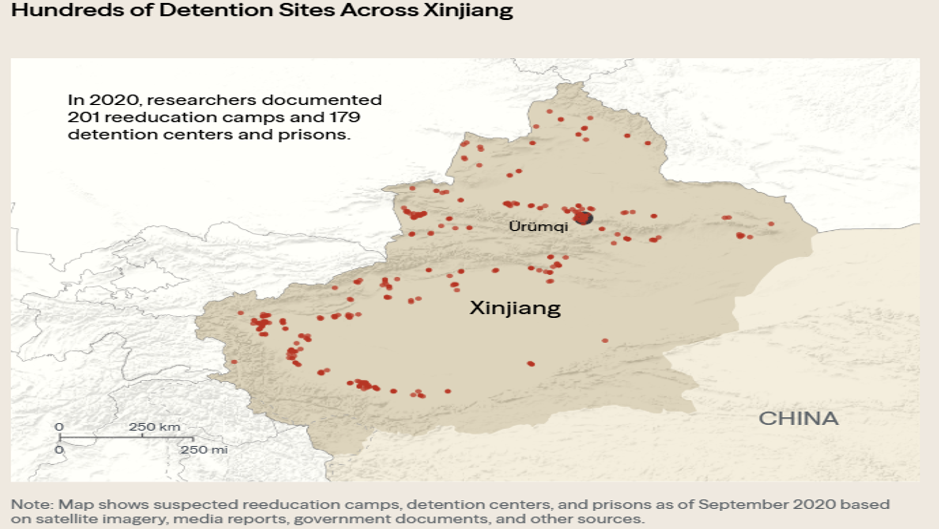
From 2020, the repression entered an even darker phase: a vast network of internment camps was built across Xinjiang. Leaked documents, satellite images and survivor testimonies show that over one million Uyghurs and other Turkic Muslims have been detained without trial in these facilities. Beijing calls them “vocational education” centres, but detainees describe political indoctrination, torture, sexual violence and forced labour. Inside the camps, people are forced to renounce Islam, sing Communist Party songs and study Xi Jinping Thought for long hours. Outside, ordinary life is also under attack: children are separated from parents, villages are monitored by dense networks of police stations, and passports are taken away to stop Uyghurs from leaving China. This is not security policy; it is an attempt to break a people’s identity.
Why March 18 matters
There is no single “start date” for Uyghur unrest, because it is a story of repeated protests crushed by a powerful state. But choosing 18 March as a day of focus can help activists and writers link past and present, and show that the Chinese Communist Party has a long history of answering peaceful demands with bullets and batons. The 18 March 1926 Massacre in Beijing, where security forces killed dozens of unarmed demonstrators, is an early example of this pattern of state violence.
Today, that same ruthless logic is applied to Uyghurs in Xinjiang, only with far more advanced tools. By marking 18 March, you highlight that what is happening in Xinjiang is not an “internal matter” but part of a century‑long habit of crushing dissent, violating human rights and denying whole communities the right to exist with dignity.